
How Wolt Works: Business Model and Courier Pay

Wolt is a Finland based startup company that works as a network of restaurants, retailers, and couriers online. It is a food-delivery platform that was founded in 2014 by Slush fame Miki Kuusi and other co-founders. How Wolt works has been a subject of great curiosity especially in the Nordics.
It was launched a year later in 2015 in Helsinki, Finland. At that time the company had partnered with 10 restaurants only. As per Bloomberg’s reports, within the next four years, the company had successfully raised $30 million in funding (January 2018).
In 2020 (Five years after the launch), Wolt has expanded itself to 23 countries and more than 100 cities. A company that started with just 10 partner restaurants has now partnered with 27000 restaurants and retailers. Sounds impressive, right? So, let’s explore its business model to understand the tips and tricks that Wolt followed to become the company that it is today. Down below are a few insights for the readers craving to know “How does Wolt work” and “How does Wolt make money”.
Wolt Business Model
Wolt follows a great and effective business model of the Sharing Economy. When the term Sharing Economy is used it simply refers to the peer to peer exchange process of services, products, or assets between private individuals, either paid or free by means of the internet. This model usually comes into existence when the price of any asset is high or is insufficiently utilized.
Today, many dominating companies like Wolt, Airbnb, Uber, etc are using this concept to enhance trade with crowdsourcing. Slowly and gradually, monopolies are coming to an end because businesses are moving towards connecting with people using Crowdsourcing. Even the crowdfunding companies like Ketto are using the sharing economy in their work process. Companies that were reserved to monopolies started thinking “How does Wolt work?” and “How does Wolt make money?” and then in the coming years, they soon realized the power of Sharing Economy
As per Finland 2018 statistics, there were 35000 more employed men and 32000 more employed women as compared to the data of 2017. The number of self-employed persons grew by 9000 in a year. [Ref:https://www.stat.fi/til/tyti/2018/13/tyti_2018_13_2019-04-11_tie_001_en.html.]
According to mid-2019 statistics in Finland, around 180,000 people are self-employed Finland.
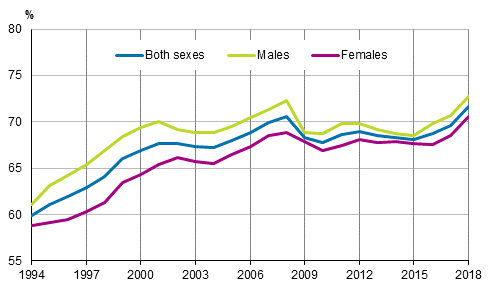
Source - https://www.stat.fi/til/tyti/2018/13/tyti_2018_13_2019-04-11_tie_001_en.html
Experts say that the sharing economy played a very important role in increasing the number of self-employed people in Finland. Companies that use the sharing economy as their business model are preferred mostly these days because they provide an extra earning platform to people.
How does Wolt make money?
The company offers a Wolt courier partnership job opportunity which is its main source of making a profit. According to the information given by the company itself, below are the types of earning that a Wolt’s courier partner can make after partnering with Wolt courier:
- Task/Base Fee
It is the fee or earnings that the Courier partner receives on completing delivery tasks while including the Straight Line delivery system from the restaurant to the delivery address.
- Distance Fee
It is the earning that Courier partners receive if the straight line delivery distance is coming up more than the one already included in the above-mentioned Task/ Base fee.
- Straightline delivery system
Wolt calculated the courier partners’ fees based on a straight line delivery system in which distance is calculated from the Restaurant to the Delivery address in a straight line and not according to the road distance.
- Available Guarantee payment
This is the payment guarantee scheme provided to all Courier partners for their availability during scheduled hours that they have pre-booked. The fees are then calculated based on Scheduled hours.
Wolt’s Business Strategy
Wolt, a Finnish startup company, focuses on developing mobile payment software to ease out the payment procedure between consumers and restaurants. Its application connects hungry customers with restaurants for food and drinks.
Wolt’s business strategy’s success resides in the fact that the company focuses on the countries where there is less competition. For example, the basic launch of the application was carried out in no other country but in Finland, because there was not much competition in the market. Until now, it has not expanded itself to the United States and Asia but is expanding thoroughly across Europe.
Who are Wolt’s Investors
As per the report by Thesus, the launch of the Wolt application became a potential point for investors. Investors often pondered over the Wolt’s business model to know “How does Wolt work?” which finally convinced them and they consequently began investing in the company.
Few months after the launch of the application in 2014, Wolt successfully raised 400,000 euros. Crunchbase's latest report mentions that at present, the company has a total of 10 investors and out of the 5 are lead investors.
Who is Wolt’s biggest Competition
The expert report 2016 says that Foodora is the biggest competition of Wolt at this present time. Foodora is also a food delivery platform running online. Customers can place their orders via the android/ iOS version of the app or through Foodora’s official website. The biggest difference between the both is that Foodora doesn’t provide food pick up service as s provided by the Wolt.
The company is originally based in Berlin, Germany and by 2020, it is being operated in the following countries:
- Finland
- Norway
- Sweden
How does Wolt work?
Wolt is a tech company that provides the facility of food takeaways and delivery. The company works by building an infrastructure of connected networks between restaurants and retailers. It connects the hungry customers to nearby restaurants using smart technology.
People can place their orders online through the Wolt app available on iOS/ Android both or they can simply go to https://wolt.com/en and place their orders. When the customer enters the website after sign up, there is a list of various nearby restaurants that are willing to prepare the order. The placed order is delivered by the couriers working with Wolt to the desired customer’s location.
At present (Jan 2021), Wolt has expanded itself in 23 countries worldwide.
Wolt also offers freelancing opportunities just like Uber. It has become a popular platform for students, immigrants, and unemployed people who are looking for job opportunities. Even the employed ones are going for it just to earn extra outside their 9-5 traditional jobs. Since it is a Freelancing job, it allows the employees to choose their own favorable working time without any time limit restrictions.
How does Wolt work for marketing?
Vehicle branding is a cost-effective marketing tool that helps your business in getting noticed by the local public. As compared to any other marketing channel or tool, vehicle branding is considered the most effective one. Wolt and Foodora both recognized this valuable opportunity and picked it up as the most effective tool to raise their brands’ awareness among the customers.
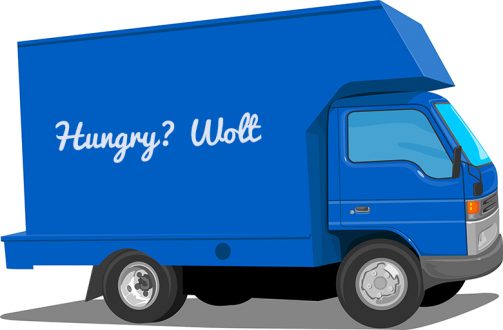
Wolt uses a distinctive blue delivery car as a source of their vehicle advertisement to create brand awareness. Below is the blue delivery car that helped Wolt in generating and strengthening public awareness about their brand.
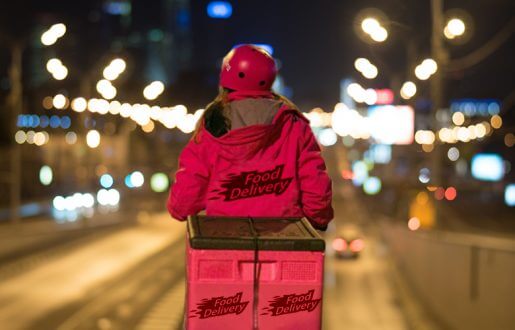
Foodora was no way behind Wolt in marketing and creating brand awareness. They chose to fully equip their staff members with the pink bicycle, pink jacket, pink helmet, and a pink delivery bag with the company’s logo. According to the experts, this color marketing strategy impressed the local audience widely as the chosen color was quite eye-catching and quickly made everyone identify the staff members of Foodora with the pink color which became one of the important company’s assets. Take a quick look at the costume of courier partners associated with Foodora in the picture, below.
How Wolt makes money per order
Wolt earns from several lines at once, which is why the unit economics matter if you are planning to replicate the model.
- Restaurant and retailer commission. Wolt charges partners a commission on every order. In most markets this sits somewhere in the 15 to 30 percent range depending on order volume, exclusivity and whether Wolt handles the delivery itself.
- Customer delivery fee. The fee at checkout varies by distance, basket size, time of day and demand, and it is waived or reduced for subscribers above a minimum basket.
- Wolt+ subscription. A flat monthly fee that cuts delivery costs. It trades short term delivery revenue for order frequency and retention.
- Promoted placement. Restaurants and retailers can pay for visibility inside the app, as sponsored listings or featured slots in category pages.
- Logistics spread. Where Wolt runs the courier fleet, it also keeps the difference between what the customer pays for delivery and what the courier partner is paid.
The margin question is not the commission alone. It is the fully loaded cost of a delivered order against the fees collected, and that is where density decides the outcome: more orders per courier hour lowers delivery cost per order, which is the whole game in on-demand delivery.
Wolt vs Uber Eats vs Deliveroo
- Marketplace model. All three run a three sided marketplace of customers, merchants and couriers. Wolt and Deliveroo lean harder on owning the delivery experience, while Uber Eats can lean on the wider Uber network for supply and demand.
- Courier model. Wolt works with self employed courier partners in most markets. Deliveroo uses a mix of employed riders and self employed couriers depending on the country. Uber Eats is almost entirely self employed.
- Subscription. All three sell a monthly plan that reduces delivery fees, and in all three the plan exists to raise order frequency rather than to make money on its own.
- Footprint. Wolt is strongest in the Nordics and Northern Europe. Deliveroo is strongest in the UK and Western Europe. Uber Eats is the broadest, and it is the one with the deepest non food delivery base.
For a new entrant the practical lesson is that the model is not the differentiator. Density in a small number of cities is.
Wolt after the DoorDash acquisition
DoorDash agreed to acquire Wolt in November 2021 in an all stock deal, and the transaction closed in 2022. Wolt has continued to operate as its own brand and platform since then, which is why the product still looks and behaves like the pre acquisition service.
What changed is the operating context. Wolt has pushed beyond restaurant food into grocery and retail delivery, expanded Wolt+ as a retention product, and leaned on DoorDash scale for logistics and merchant tooling. For anyone studying the model, that matters: the standalone food delivery business is hard to make profitable, and the retail categories are where the economics improve.
What it takes to launch a Wolt style platform
If you are building a competitor, the technology is the easier half. These are the pieces that actually decide whether it works.
- Three sided onboarding. Separate flows for customers, merchants and couriers, each with its own verification and payout rules.
- Live order state machine. Placement, acceptance, preparation, pickup, delivery and settlement, with handling for cancellations and partial refunds at every stage.
- Dispatch and batching. Courier assignment by distance, load and predicted preparation time, then stacking nearby orders to protect margin.
- Pricing engine. Delivery fee, surge, minimum basket, commission tiers and promotions, all configurable per city.
- Merchant tooling. Menu management, stock toggles, order tablets and settlement reporting, because merchants churn fast when this is clumsy.
- Payments and payouts. Card capture at order time, split settlement to merchants, and scheduled courier payouts with a clear statement.
Our food delivery app development page covers the build in more detail, and the on-demand delivery page covers dispatch and courier economics. If grocery is part of your plan, read the grocery delivery breakdown, and if you are starting from an existing restaurant base, restaurant app development is the shorter path.
Frequently asked questions
Does DoorDash own Wolt?
Yes. DoorDash acquired Wolt in a deal announced in November 2021 and completed in 2022. Wolt continues to operate under its own brand.
How much does Wolt charge restaurants?
Commission is negotiated per market and per partner, and it typically falls in the 15 to 30 percent range of order value. Delivery fees and promotional spend sit on top of that.
How do Wolt couriers get paid?
Couriers are paid per delivery, usually as a combination of a base task fee plus distance and time components, with bonuses during peak demand. In most markets they work as self employed partners.
Can you build a Wolt style app without a courier fleet?
Yes. Marketplace only models let merchants deliver with their own staff, which removes the logistics cost but weakens control over delivery time and experience. Most new entrants start marketplace only in one city and add fleet delivery once order density supports it.
Summing-Up
This particular article presents the Wolt Business Model to answer the common questions arising in the minds of readers, i.e. “How does Wolt work” and “How does Wolt make money”. From the inception where the customer needs to create an account on the app/ website and place the order to the food delivery system, everything is done in a well-organized way. The Wolt Business Model sets an amazing example for all the budding entrepreneurs to come up with a unique idea and nurture it with self-belief as- “Believing yourself is the first step towards success”.
If you’re willing to start your own food delivery platform - you should go with Wolt Clone, which has customized features to let you roll with your own delivery business.
Here are some other informative articles explained by NCrypted Websites:
- Ola Acquires Foodpanda India to set foot in On-Demand Food Delivery
- 5 Guidelines for your next ‘Uber for X’ startup before getting funded
- Postmates Business Model - Know How does Postmates Work & Make Money
Related guides
 Food Delivery & On-Demand
Food Delivery Apps: How They Work and Make Money
In the current scenario, home deliveries have been precious. Food delivery apps have seen a surge in their use. Several safety issues have been debated. Still, food delivery companies...
Read guide Food Delivery & On-Demand
How Uber Works: Business Model and Driver Pay
In today's fast-paced urban landscapes, convenience reigns supreme, and no other company epitomizes this more than Uber. Since its inception in 2009, Uber has emerged as a trailblazer...
Read guide Food Delivery & On-Demand
What Is Grubhub? How It Works and How It Makes Money
Grubhub is an on-demand food delivery service. It operates on both a website and mobile application. The Grubhub mobile application is available for both iOS and Android. It was...
Read guide