
How Poshmark Works: Fees, Selling and Payouts

Poshmark has redefined the fashion resale market by offering a user-friendly platform that combines social networking with e-commerce. By empowering users to buy, sell, and engage with each other in a vibrant community setting, Poshmark has created a unique and compelling shopping experience that continues to attract millions of fashion enthusiasts worldwide. Whether you're looking for the latest trends or seeking to declutter your closet, Poshmark offers a seamless and engaging platform to satisfy your fashion needs.
Technological developments have reshaped how users connect with brands, and they now greatly impacting the e-commerce world. Empowering the users to identify the lowest prices has never been easier. The trend of fashion e-commerce is booming these days, more customers prefer shopping for their fashion items online, as they can get everything at their doorsteps.
With an increase in the demand for online purchases, more and more businesses are now moving to e-stores from the brick and mortar stores. From the reports and analysis, it has been observed that more than 65% of people prefer to purchase goods online and this figure is increasing day by day.
Technology forms the backbone of fashion e-commerce. It helps to connect sellers and buyers on the web and mobile platforms, and with that it enables the effective management of everything related. Taking inspiration from this, Poshmark came into the picture. Poshmark is an e-commerce platform that deals with the fashion industry. You might be thinking of getting in-depth details on ‘what is Poshmark’ or ‘how does Poshmark work’ or ‘how does Poshmark make money’, right? To better understand it, let's start with "What is Poshmark?"
What is Poshmark?
Poshmark can be termed as a fashion ecommerce platform that drives online buyers. The process over here is like browsing offline and then buying online. Hence, buyers and sellers over here can leverage this well-known tool to like and share the items they like. As a buyer, you can even follow the sellers whose inventory is interesting to you.
Poshmark business model is really easy to use and can benefit both sides that are, buyers and sellers. It's not surprising to learn that the platform has attracted over 1.5 million sellers and millions of engaged buyers, who add approximately $3 million worth of inventory to the site daily.
The Poshmark platform has taken the shop-and-buy for fashion to a whole new level, specifically on the social level. This e-commerce marketplace focuses more on being a bridge between buyers and sellers who are looking to either purchase or sell fashion accessories, fashion items, and such luxury goods. Poshmark even allows users to sell their unworn or unwanted clothes and has a secure payment method.
This was just a glimpse of "what is Poshmark." Now, let's shed some light on how Poshmark works.
How Does Poshmark Work?
Poshmark Demystified: Understanding the Inner Workings of the Fashion Resale Platform
Poshmark has emerged as a go-to destination for fashion enthusiasts looking to buy, sell, and discover trendy clothing and accessories. But how exactly does Poshmark work, and what sets it apart from other online marketplaces? Let's unravel the mechanics of Poshmark and explore how this innovative platform connects buyers and sellers in the world of fashion.
Overview of Poshmark:
Poshmark is a social commerce platform that allows users to buy and sell new or gently used clothing, shoes, accessories, and beauty products. Launched in 2011, Poshmark has since grown into a thriving community of millions of users, spanning various fashion styles, sizes, and brands. Whether you're hunting for designer deals or decluttering your closet, Poshmark offers a seamless and engaging shopping experience.
Listing Items for Sale:
Sellers can list items for sale on Poshmark by creating listings with photos, descriptions, and pricing details. Sellers have the flexibility to set their prices, upload multiple photos, and provide detailed descriptions to attract potential buyers. Poshmark provides sellers with shipping labels and handles payment processing, making it easy to sell items without the hassle of managing logistics.
Sharing and Engagement:
Poshmark is built on a social networking model, where users can engage with each other by sharing listings, following other users, and participating in virtual "Posh Parties." Sellers can share their listings to their followers and to Poshmark's broader community to increase visibility and attract buyers. This social aspect of Poshmark fosters a sense of community and encourages users to interact and discover new items.
Offers and Negotiations:
Buyers can make offers on listings to negotiate prices with sellers. Sellers have the option to accept, decline, or counter offers, enabling them to negotiate prices and close deals that work for both parties. This feature allows buyers to score deals on their favorite items while giving sellers the flexibility to adjust prices based on demand and market conditions.
Purchase and Payment:
When a buyer purchases an item on Poshmark, the payment is processed securely through the platform. Poshmark holds the payment until the buyer receives the item and confirms its receipt and condition. Once the transaction is complete, Poshmark releases the payment to the seller, minus a small commission fee, which varies depending on the price of the item.
Shipping and Delivery:
Poshmark handles shipping logistics for sellers, providing pre-paid shipping labels that sellers can use to ship items to buyers. Sellers are responsible for packaging and shipping items promptly after a sale is made. Buyers can track the status of their orders and communicate with sellers through the platform to ensure a smooth and seamless delivery experience.
Seller Protection and Buyer Guarantee:
Poshmark offers seller protection and buyer guarantees to ensure a safe and secure shopping experience for all users. Sellers are protected against fraudulent buyers and unauthorized returns, while buyers are guaranteed to receive their orders as described or receive a refund. This assurance of trust and transparency encourages users to buy and sell with confidence on Poshmark.
To have a better and clearer understanding of ‘How does Poshmark work?’ We will divide it into two parts: buyers and sellers.
How Does Poshmark work for Sellers?
Observers have noted that this platform creates value for sellers in a couple of ways. Poshmark has an intuitive app-based interface that makes it simpler for the sellers to upload any inventory.
As a seller, the first and foremost thing required is to sign up and create an account. Further, you need to upload pictures of whatever things you would like to sell. The important thing to mention here is the description, retail price, and proposed price. With all this, you can select the tags which seem relevant to your item.
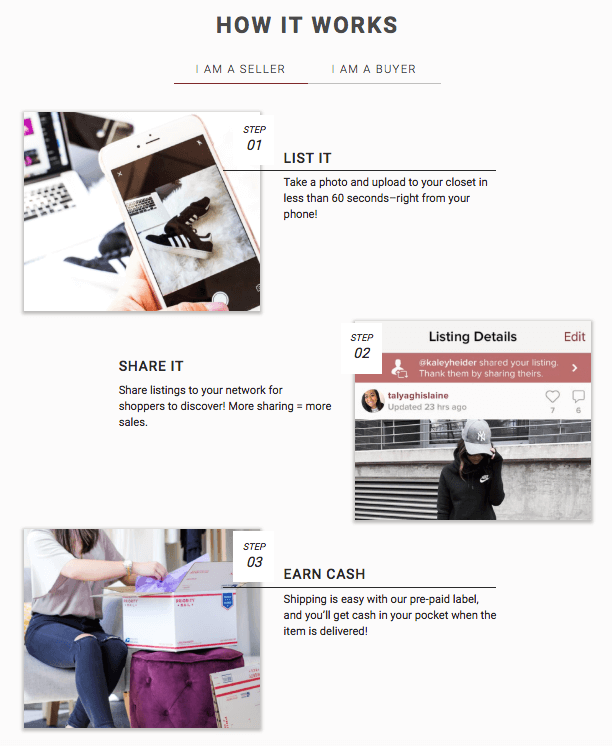
Accordingly, the sellers can have much control of the process. Poshmark even provides prepaid postage labels to sellers, so that the shipping process can run smoothly. The funds will be deposited into the sellers account once the buyer has “accepted” the order or else after 4 days of successful delivery of the package.
To generate interest in their products, sellers are provided with various “Posh Parties” notifications on the platform. The seller will get a notification whenever certain theme parties are taking place such as “Best in Outwear party” or “Everything Kids party”. Henceforth, sellers can join the parties and can share their relevant merchandise.
How Does Poshmark Work For Buyers?
For buyers, this platform creates value by making it more convenient to find the items and even to stay updated on every new change being made.
For instance, a seller leverages a category named “parties”, thus, a buyer can search easier with the help of tags as per the niches. Additionally, by commenting and liking merchandise, the buyer will have a chance to learn more about a product and will be notified if there’s a change in the price of an item they “liked”. Buyers over here can privately negotiate the price of an item with the seller.
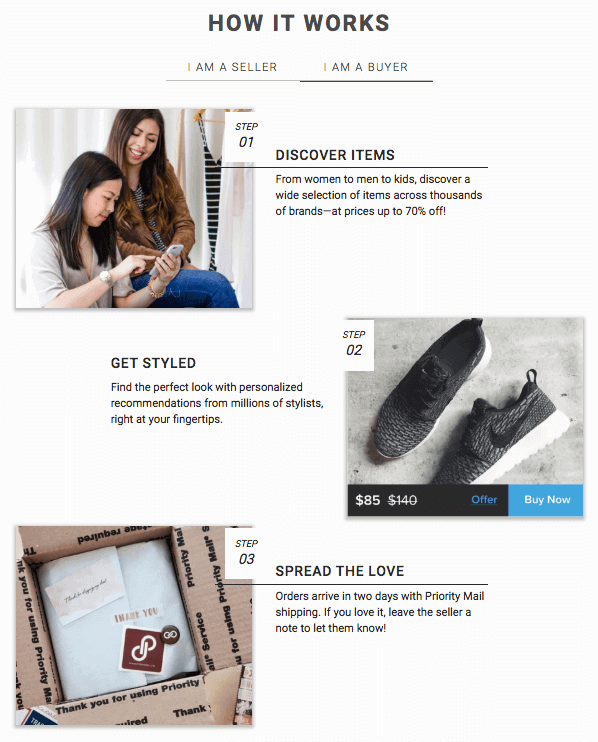
Merchandise can be sold at the “advertised price”, a new price that a buyer has countered with, or a price proposed by the seller. Offers will expire within 24 hours it being made, although the process of negotiation lasts longer. Once the buyer and seller agree on a price, the buyer needs to accept the item in 3 days after it is received. If the product is not up to the mark, the buyer can open a “case”, hence when the case is pursued Poshmark looks into the item, and compares it. If Poshmark agrees with the issue raised, the refund will be provided to the buyer.
How are Payments handled on Poshmark?
On Poshmark, the banking portion is handled securely through the platform. When you sell an item on Poshmark and the transaction is completed, the funds from the sale are held by Poshmark until the buyer receives the item and confirms its receipt and condition. Once the buyer accepts the item, Poshmark releases the funds to you, the seller.
Here's how the process works:
- Payment Processing: When a buyer purchases an item from your closet, Poshmark securely processes the payment through the platform. The buyer pays for the item, plus any applicable shipping fees, using their preferred payment method.
- Hold Period: After the buyer completes the purchase, Poshmark holds the funds from the sale until the buyer receives the item and confirms its receipt and condition. This hold period is typically a few days after the buyer receives the item, allowing them time to inspect it and ensure it matches the description and photos provided in the listing.
- Release of Funds: Once the hold period expires and the buyer confirms the receipt and condition of the item, Poshmark releases the funds to you, the seller. The funds are deposited into your Poshmark account balance, where you can view your earnings and use them to make purchases on Poshmark or withdraw them to your bank account.
- Withdrawal Process: To withdraw your earnings from Poshmark to your bank account, you can initiate a withdrawal request through the platform. Poshmark typically offers two withdrawal options: direct deposit or paper check. If you choose direct deposit, you'll need to provide your bank account information, including your routing number and account number, to link your checking account to your Poshmark account. Once your bank account is linked, you can initiate a direct deposit withdrawal, and Poshmark will transfer the funds directly to your checking account.
- Timing of Withdrawals: Withdrawal requests may take a few business days to process, depending on your bank's processing times and Poshmark's internal procedures. Once the withdrawal is processed, the funds will be deposited into your checking account, and you'll receive a notification from Poshmark confirming the transaction.
Overall, Poshmark provides a secure and convenient way to sell items and receive payments, with built-in protections for both buyers and sellers. By handling payment processing and fund transfers through the platform, Poshmark ensures a smooth and seamless transaction experience for all users.
How Does Poshmark Make Money?
As per the latest reports, the company value reaches $ 625 million. It has even partnered with Amazon to link its app to Alexa. So, how does Poshmark make money, in such a difficult space?
There are several ways through which business platforms can generate revenue. Poshmark makes money in different ways, right starting from taking a fee from every sale made by its users. It’s free to list on the platform, here Poshmark will directly deduct a fee from the listed price once a product has been sold. The deduction goes like this, for sales under $15, the fee deducted will be a single flat rate of $2.95. And for sales of $15 or more, the deduction will be 20 percent of the listed prices.
With that Poshmark provides sellers with free credit card processing, free prepaid shipping labels, free customer support, and Posh Protect buyer protection for the buyer. There is a flat rate of $6.49 for expedited shipping for every order which is to be paid by the buyers,
Most of the revenue generated by the Poshmark is through commissions or fees received from the users. This might have solved your question about how does Poshmark make money? Therefore let’s now deep dive into the Poshmark business model.
Poshmark Business Model
So, what do you think, why the company is doing so well? It is just because of the Poshmark business model - unlike many others, it has no such inventory. Without needing to buy the clothes itself, Poshmark has less overhead, than its competitors. Just as some folks are becoming major influencers on social media and hence can make money by promoting products to their followers, over here the seller's stylists are at the core.
The unique Poshmark business model will allow these influencers to have a captive audience and therefore help the people to build style. With a good hold, Poshmark grows followers in the marketplace.
Concerning the Poshmark business model, their success is much more reliant on the social-media process by building a network and further selling products to the followers. Another advantage of Poshmark is that it has an app available which helps the company acquire a mobile user audience as well.
How to start a business like Poshmark?
After knowing all about what is Poshmark and how does Poshmark work, if you are interested to start a similar business, then yes, you are at the right place. NCrypted Websites will help you to build your Poshmark Clone as per your niches.
With that, we also have our own product named ‘Fashmark’, a multi vendor script ecommerce script. It is especially for buying and selling goods for any industry or market segment. If you are looking for ecommerce startup and in plan to build a custom website, our team will even help you with that. Get in touch with us, to build your Startup.
Poshmark fees in practice: what sellers actually keep
The fee structure is simple on paper and worth walking through with real arithmetic, because it changes how sellers should price. Below a low price threshold Poshmark charges a flat commission. Above it, the fee becomes a percentage of the sale price. Shipping is separate and is normally paid by the buyer.
The practical consequence is that very cheap items are uneconomical to sell. If a flat fee eats a large share of a ten-dollar sale, the seller keeps almost nothing. This is why experienced sellers bundle inexpensive items into lots and price individual pieces above the threshold where the percentage model applies.
It also shapes the negotiation culture. Because buyers can make offers and sellers can counter, the fee is calculated on the final price rather than the list price. A seller who accepts a steep discount cuts their payout twice: once from the lower price, and again because a flat fee becomes a larger share of a smaller sale.
Sellers should also account for packaging, their own time, and the risk of a return. Buyer protection lets a buyer open a case if an item does not match the listing, so accurate descriptions and clear photographs are not just marketing, they are loss prevention.
How Poshmark compares with eBay, Etsy, Depop and local resale apps
The clearest way to understand Poshmark's position is to compare who each platform is built for.
eBay is the generalist. It has the widest inventory and the strongest search behaviour, which makes it good for hard-to-find items, but it offers little community and heavy competition on price. Etsy is built around handmade and vintage, with a craft identity that does not suit mass-market fashion resale. Depop and similar apps target a younger, trend-driven audience where aesthetics and following matter more than catalogue depth. Local resale apps and classifieds win on convenience and no shipping for bulky items, but they have no payment protection and no national reach.
Poshmark's differentiator is the social layer. Following, sharing, and themed selling events create repeat discovery that a pure search marketplace does not have. That matters because resale inventory is long-tail: most listings are one of a kind, so a search-only model struggles to surface them.
If you are weighing a generalist route instead, our overview of a classified script and a marketplace script explains the listing, messaging, and payment foundations that general marketplaces share.
Common problems sellers run into
Most complaints on resale platforms fall into a small number of categories, and each has a workaround.
- Slow sales. Single listings that are not shared regularly fall out of feeds. Consistent sharing and relisting is the standard fix.
- Returns and cases. Items that arrive not as described are the main source of disputes. Detailed measurements, condition notes, and photos of flaws reduce them sharply.
- Low-value inventory. Cheap items rarely justify the fee and the effort. Lotting them usually beats listing each one.
- Counterfeit risk. Branded goods attract scrutiny. Sellers should keep proof of purchase and be ready to verify authenticity.
- Cash flow timing. Funds are released only after the buyer accepts the order or the acceptance window closes, so plan around a short delay rather than an instant payout.
What it takes to build a resale marketplace like Poshmark
A fashion resale platform is a marketplace with three unusually demanding layers: trust, logistics, and social discovery.
Trust comes first. You need verified accounts, secure payment holding, a dispute process with evidence uploads, and a returns policy clear enough to apply at volume. Without that, buyers will not send money to strangers and sellers will not ship goods.
Logistics comes second. Resale works best when the platform supplies prepaid, tracked shipping labels, because that removes the single biggest friction point for casual sellers. That requires carrier integrations and rate negotiation at volume.
Social discovery comes third. Feeds, follows, sharing, and curated events are what turn a catalogue into a community, and they need to be designed into the product from the start rather than bolted on later.
Underneath all three sits a catalogue and order management core. Our ecommerce script covers the product, cart, and payment side, and the eBay style marketplace build shows how multi-seller listings, offers, and seller ratings are structured.
Frequently asked questions
How much does Poshmark take from each sale?
Poshmark charges a flat commission on low-priced sales and a percentage on higher-priced ones, with shipping normally paid by the buyer. Check the current fee page before pricing, because thresholds are updated from time to time.
Do sellers pay to list items on Poshmark?
No. Listing is free, and the platform earns only when an item sells. That is why the fee is deducted from the payout rather than charged upfront.
When do sellers get paid on Poshmark?
Funds are released after the buyer accepts the order, or after the acceptance window closes following delivery. The money then sits in the seller's balance until a withdrawal is requested.
Can I sell on Poshmark from outside the United States?
Poshmark operates primarily in the United States and Canada, and shipping rules are tied to those markets. Sellers elsewhere should confirm eligibility and payout options before listing.
Share Your Thoughts With Us!
How well did you like our blog on “How does Poshmark Work? A Complete Walkthrough Explaining This Unique E-Commerce Platform” Did we miss out on any point? Do share it in the comment section below.
Related guides
 Marketplaces
How Does Ebates Work? Cash Back and Payouts
Read guide Marketplaces
How Does DealDash Work? Bids, Costs and Fees
In the realm of online auctions, DealDash stands out as a trailblazer, transforming the way consumers shop and interact with e-commerce since its inception. Founded with a vision to...
Read guide Marketplaces
What Is Nextdoor? How It Works and Who Can Join
Nextdoor is a neighborhood-focused social networking platform designed to connect people living in the same local area. It allows residents to communicate, share information, and...
Read guide