Home Blog Page 5

Top 10 On Demand Services in the Developed Countries You Need to Know in 2025

0

We live in an era where every business aims to fulfill the complete demands of its target customers. With a few taps on our smartphones, we can have everything delivered to our doorstep – a dream come true for us as consumers. However, as an entrepreneur, this opens up a whole new ecosystem of on-demand services for you.

Today, almost every startup and business has realized the potential growth in this sector and has started investing in its development and launch. The on-demand economy is now playing a significant role in driving the economies of various developed countries. Industries adopting this change are not just booming but expanding at rapid rates. According to PwC research, the on-demand business will grow to be worth close to $399 billion by 2032. In this article, we will cover the top 10 on-demand services that are currently expanding in developed countries. Simultaneously, the reasons why the on-demand industry is becoming so popular will be discussed.

Know more: How does on-demand work

Unlocking the success of on-demand services

As the world embraces the on-demand economy, the industry continues to offer millions of profit to businesses and a lot more comfort to customers daily. The adoption of disruptive technologies is consistently optimizing the customer experience.

There has been a rise in the gig economy, but knowing the reasons behind the growth is also very important. Here are some of the influential factors behind the skyrocketing growth:

Contact-free delivery

Contactless delivery has become the new normal post-COVID. The pandemic has brought about uncommon changes in human behavior as businesses that used to offer home deliveries have embraced contactless delivery methods to meet customers’ expectations. As a part of this, companies have started implementing a contactless delivery process. Here, the delivery agent leaves the package at the customer’s door and calls to pick it up from outside. Along with that, the payment processes have also gone completely online by accepting cash-on-delivery options.

Increased emphasis on entrepreneurship

On-demand software solutions have brought a wave of entrepreneurship and freelancing. They have allowed employees to choose their working hours and get paid based on the amount of work completed. This work culture has made life easier for freelancers and entrepreneurs to find work online and is life-changing for those who wish to pursue multiple gigs. The company culture has also been greatly impacted, and everyone now respects each other’s spirit of entrepreneurship.

Increased possibility of customization

Customers today have high expectations of companies. Everyone today is looking for customized solutions. They are unhappy with conventional business practices and want every organization to operate in a way that allows customers to have an extremely engaging experience.

With this, there has been a humongous growth in opportunities for companies and enterprises.

Wide scalability

Services offered by on-demand apps are very safe and scalable. Because of this, incorporating them into your business operations gives you a highly scalable solution to satisfy the diverse needs of your firm.

These recommendations have persuaded business owners and marketers that converting to the on-demand business model is essential because it is more profitable than the conventional strategy.

Product replacement and refund policy

Returning goods is a major concern in physical stores. You must have the receipt, visit the store, speak with the concerned employee, wait, and then determine the likelihood of obtaining a product replacement. However, it is only a customer service request away when it comes to on-demand services, particularly e-commerce.

Or, in certain companies, clients need to access their dashboards to place a replacement purchase. Additionally, buyers have the choice between a full refund and a credit. Customers once more do this from the convenience of their homes, increasing the dependability of on-demand services.

On-demand services in developed countries

On-demand food & grocery delivery services

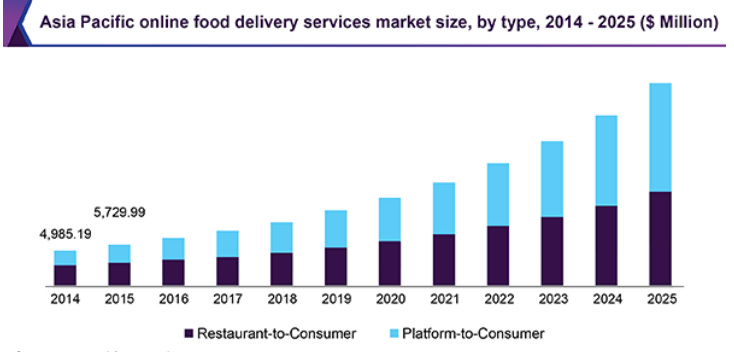
The on-demand delivery model has been growing at a very fast pace and is going to stay in the market for a much longer time. No one can deny the fact that food solutions are always in demand. According to Statista, the US market for online meal delivery generated US$306,808 million in sales in 2021 and is anticipated to expand at a rate of 10.01% a year (CAGR 2021–2025), with a predicted market volume of US$449,292 million by 2025.

Food and grocery delivery is one of the most common services flourishing in most developed countries. It not only offers a concept of food delivery in no time to customers but also provides restaurant owners with better opportunities to sell their products.

Companies like Uber Eats, GrubHub, Instacart, Glovo, and Postmates are a few of the names that are offering such services and ruling the markets of developed countries.

Read more:

On-demand home services

On-demand home services are also one of those sectors that is the talk of the talk these days. The demand for home services is increasing day by day as people are getting engaged in their hectic daily schedules. Every second person is seeking some assistance to manage their household activities effortlessly.

On-demand home services can be classified as:

  1. House cleaning services
  2. Repair services
  3. Babysitting
  4. Pet care
  5. Pest control services
  6. Carpentry
  7. Others

Statista’s most recent data indicate that in 2014, on-demand home service apps only brought in a total of USD 97.7 billion worldwide. The global income number, however, shot up to USD 581.9 billion in 2020 and is projected to reach an astounding USD 935.2 billion by 2023. Thumbtack, TaskRabbit, Urban Company, HouseJoy, Zimmber, Mr. Right, and Handyman are a few of the famous companies that offer such services.

On-demand health services

If you are unable to get your doctor’s appointment, you are in a far-off location, or you do not have time to see a doctor, on-demand health services can help you counter all such situations. They have got your entire healthcare covered.

The telemedicine industry is quickly developing after the pandemic and is continuously adopting emerging technologies to provide the best experience to users. Not only does it allow you to book your doctor’s appointment, but it also delivers all your prescribed medicines to your home. Not only that, many apps have additional features where you can get your basic health check-up and get recommendations for your health problems by just answering a few questions. You can even set medicine reminders in the app itself.

Here are a few names that are popular in the telemedicine industry:

  1. MDLIVE
  2. Doctor on Demand
  3. Amwell
  4. Teladoc
  5. LiveHealth
  6. HealthTap

On-demand salon services

According to Fortune Business Insights, there has been a growing trend of salon services globally as a large number of people are becoming increasingly desirous of having good looks. This global population becoming conscious of their looks is the driving factor for the market growth in this sector.

With the increasing growth in this sector, companies are coming up with tech solutions to modernize traditional salon services. Mobile apps are making it possible to offer on-demand services to clients. This is the best solution for those who have a busy schedule and who do not have time to visit the salon and undergo long-duration processes. Using the at-home salon beauty service allows such clients to book a beauty professional and enjoy the services at home. Users can even book their appointments at a beauty salon or spa center with beauty-on-demand apps.

On-demand car wash services

On-demand car wash services are also becoming very popular these days. Installing an on-demand car wash mobile app will be your best option if you want to have your car cleaned but don’t want to stand in long queues or waste time scheduling the service and waiting for your turn. Car washing is faster and easier with on-demand apps. You can just book the service through the app and choose your time slot as per your comfort.

Businesses are focusing on such services. There is a huge possibility of success because most people have cars today, and everyone wants to own a well-maintained one. A professionally cleaned automobile might cost anywhere between $30 and $50. Accordingly, the cost to have one’s car washed every month for the ordinary person is between $80 and $100. Up to 60% of individuals utilize vehicle wash services in the United States alone. These services produced a significant amount of revenue. There are around 100,000 car wash facilities worldwide, and Americans spend $5.8 billion annually on car washes.

On-demand travel and transportation services

Today, you are no longer required to stand in long queues to book your travel tickets or worry about getting a hotel for your next trip. On-demand travel apps have got you covered in this. They help you smooth your entire travel journey and try their best to give you a unique experience. With a few clicks, you can book your desired hotel in your desired location with the minimum possible costs, and guess what? You can even book your taxi through these apps. It works wonders for travelers since these apps have everything one needs to plan a smooth trip.

The on-demand transportation services are in no way behind. It has been around for a while now. Earlier, people used to dial up to schedule a car, but now it’s all on our smartphones. App-based services are being used to connect users to a fleet of privately owned vehicles. A universe of options is becoming available to us thanks to our smartphones. We have the choice of taking a scooter, a cab, some form of public transportation, or single occupancy vehicles (SOVs) to get to work. In many places, it is even possible to use a smartphone to locate the nearest bus stop and board at a convenient spot.

On-demand fitness services

Not only do entertainment platforms today offer video streaming, but online fitness platforms are also in the game. However, they offer live/ recorded streaming of workout programs.

The two main drivers driving the growth of the fitness app market are the rise in usage of fitness mobile applications and the rise in demand for wearable fitness tracker devices among people around the world. Today, more and more people are becoming health-conscious, and they choose the fitness industry, which has lots of diverse solutions to offer. The mobile market promotes the widespread trend of healthy living by providing a variety of solutions that can be used in any circumstance. Thus, the creation of fitness apps brings up exciting opportunities within the healthcare sector.

The size of the worldwide fitness app market was estimated at USD 1.1 billion in 2021, and it is anticipated to increase at a CAGR of 17.6% from 2022 to 2030. The COVID-19 epidemic caused widespread lockdowns and social segregation rules, which aided in the shift from conventional studios and gyms to virtual fitness. As a result, there have been more downloads and subscriptions to fitness apps. Fitness apps were placed number 13 in terms of 2019 fitness trends, according to research released by the American College of Sports Medicine (ACSM).

These apps provide their users with individualized exercise plans by leveraging machine learning, artificial intelligence, and other technologies. They also provide customized health and fitness trainers, no-equipment workout programs, step tracking, diet monitoring, and customizable diet charts. The market is anticipated to have greater growth potential as a result of these services and advantages over brick-and-mortar stores.

On-demand entertainment services

Entertainment-on-demand is another booming service that businesses today are going for. The popularity of on-demand streaming services to watch TV shows, series, documentaries, and movies has significantly increased since the launch of Netflix and Amazon Prime.

On-demand entertainment services are one of the fastest-growing sectors in recent days. It was estimated that, by 2023, 18.5% of users would be using video streaming apps for their daily entertainment purposes.

When we talk about the top on-demand video streaming platforms, YouTube is at the top of the list. Other platforms include Hotstar, Hulu, Amazon Prime, Netflix, etc.

On-demand cooking gas delivery services

The region’s imports from LPG-producing nations like the US and Saudi Arabia are set to increase due to the anticipated rise in demand for the fuel brought on by government initiatives in Asia, with India and China emerging as the main consumers. With continued growth in the number of natural gas fields being developed across LPG-producing countries, the outlook for LPG supply is likewise getting better. Additionally, governments in developing nations are making efforts to inform the rural populace about the advantages of using LPG.

Witnessing the growing trend, on-demand cooking gas delivery will be in high demand in the future. Future technology will undoubtedly include some novel characteristics as a result of ongoing development. Therefore, now is the ideal time to create a cutting-edge on-demand cooking gas distribution system for your company.

On-demand fuel delivery

On-demand fuel delivery is a fresh concept in the market and is a quickly expanding domain. However, many companies have stepped into this sector and are generating great revenue.

Here is the list of some of the globally recognized fuel delivery apps:

  1. Yoshi
  2. Fuelster
  3. Booster Fuel
  4. Fuelbuddy

On-demand fuel delivery services are having a significant impact on the current oil and gas business by providing exceptional customer service. In the coming years, an increasing number of gas delivery startups will offer their services to both businesses and consumers. However, the complicated flow process and architecture require a powerful tech stack.

Conclusion

Since the on-demand economy is flourishing today, the demand for on-demand app development has also surged. Companies are looking for IT partners who can help them launch their businesses in this industry. Choosing the right business partner is not an easy task, but once done correctly, it works wonders. We at Ncrypted Technologies have years of experience in this field, and we have successfully helped thousands of visionaries in launching their business solutions.

If you are also willing to launch your on-demand mobile app, NCrypted Technology has perfect solutions developed by our innovative and competent workforce. We offer customized and innovative features as per your requirements to let you launch a successful on-demand platform.

10 Important Service Industries that really drive the on-demand economy

0

On-demand services are the talk of the town these days. These services are replacing the traditional business models faster than we could have ever imagined. Today, almost every business, be it small or a renowned organization/ brand has launched its business app. Businesses have made humongous changes in their business models to cater to the customer’s needs and meet their expectations.

The PWC report has estimated that by 2025, on-demand apps will touch approximately $335 billion. This data itself predicts the growth of the sector in the coming years.

First, let’s understand the in-depth meaning of the on-demand economy. Further, we’ll look into the top 10 service industries that drive the on-demand economy while replacing the entire traditional business sector.

What is an On-demand economy?

The economic activity developed by online marketplaces and tech firms to meet customer demand for quick access to products and services is known as the “on-demand economy.”

This particular economy is revolutionizing commercial behavior in cities (mostly) and towns all around the world. With the growth of the internet and on-demand apps, consumer behavior is changing to prioritize fast, desirable, user-friendly, and efficient experiences, and hence the on-demand economy is booming these days. Businesses and Industries driving this economy have put years of effort into technological advancements and changes in customer behavior.

How does the on-demand economy work?

The on-demand economy works by connecting suppliers and consumers via technology, based on rapid demand. This economy is driven by on-demand business model. The aim is to connect consumers to the right service provider at the right time. This connection happens through technology services such as a website or a smartphone app.

Whenever consumers require service, they can easily open the app and enter their required details. The algorithm behind the app/website works to send a request to the appropriate service provider. This gets back to the consumer for acknowledgment once the request is approved by him. The service provider then performs the task of fulfilling the consumer’s request. Upon the completion of the task, the payment process takes place through the application. Hence, the technology company is the intermediary in the entire process.

What are the advantages of an On-demand economy?

There are many benefits of an on-demand economy. Primarily the real-time fulfillment of customers’ demands, including the ease of connecting with a skilled service provider in the hour of need is the most appealing advantage.

Down below, we have curated a list of advantages of an on-demand economy in brief:

  1. Businesses can fulfill the needs of their customers in a fast, efficient, scalable, and cost-efficient way
  2. Overhead costs are reduced
  3. There has been an increase in opportunities for freelancers
  4. Hourly pay and work on demand are possible for this service
  5. Flexible scheduling is possible
  6. Businesses get a huge customer base through technology

Industries driving the on-demand economy

On-demand Food delivery industry

Reaching out to more and more customers has never been easy until the emergence of online food delivery apps. This industry is the most profitable one when compared to other industries. The way customers consume food items today has changed dramatically. People now prefer the comfort of home over everything.

Food solutions are always in demand, so it’s a perfect sector if you are thinking of starting a business. But with opportunities come challenges too. It’s not so easy to survive in a highly competitive market where food tech giants like Just Eat, Uber Eats, Grubhub, DoorDash, and Postmates are already competing with each other. Know more about these food delivery startups in our separate article – list of top food delivery apps.

According to Statista, the US market for online meal delivery generated US$306,808 million in sales in 2021 and is anticipated to expand at a rate of 10.01% a year (CAGR 2021–2025), with a predicted market volume of US$449,292 million by 2025.

The online food delivery market has already matured in countries like the United States, the United Kingdom, and India. However, it is still expanding in many other countries, including Saudi Arabia.

Check out our services and guide on food delivery app development if you are planning to venture into one yourself.

On-demand transportation and travel industry

Whenever there’s talk of on-demand transportation and travel services, Uber is ruling everyone’s heart in almost all major countries around the world. Uber started its operations in 2009, and since then, a myriad of transportation and travel services have appeared.

We have an analysis below from Crunchbase by Sunil Rajaraman.

The data depicts that more than 75% of the funding has gone to 5 “on-demand” startups, and out of these, 4 startups belong to the on-demand travel and transport industry itself.

Research indicates that the market for on-demand transportation will grow between 2018 and 2025 at a CAGR of 19.8%.

The on-demand travel solutions have changed the way people used to travel. The traditional ways were too hectic to follow, but now, the whole process has turned very smooth. From online ticket booking to hotel and logistics, on-demand travel solutions have got your travel plans completely covered. There’s no need to worry about last-minute checkout or making a last-minute booking; online travel services are there for you every time. You can access their services anytime via their application and book your tickets. They are a life savior for travelers.

The features of the app vary from company to company. To enhance the application, companies are nowadays adding map features to help the user. To reach their destination, book restaurant tickets, get information about the famous places to visit near you, and much more.

On-demand Logistics industry

Since the logistics and courier industry has become a part of the on-demand economy, the sector has witnessed significant growth in its business operations. Ecommerce applications are the backbone of this industry. The more people place their orders through these eCommerce apps, the more profit the logistics industry gains. People place their orders online, and the fulfillment partner plays the role of delivering them to the customer’s doorstep through seamless logistic service.

With the aid of real-time customer alerts and SMS courier tracking, technology has significantly contributed to the expansion of the sector and the inclusion of smaller businesses. On-demand system apps have not only turned its operations more efficient and seamless but also expanded its customer horizon to a greater extent. To meet the customer’s expectations, the logistics industry is continuously adding new features to its technology apps to make the process more customer-friendly. The addition of the map feature allows the customer to track the order until it reaches the final destination. A few popular names in the industry include Postman, DoorDash, GXO Logistics, DHL, Uber Freight, Blackbuck, and many more.

With the advancement of technology, new integrations like AI, IoT, Blockchain, and Machine Learning will make the industry stronger. This will indeed break through all our imaginations.

On-demand education industry

Online learning has made it possible to learn anything from anywhere and at any time. Education is not just limited to schools and colleges with e-learning concepts. Following traditional learning concepts is so old school now. With e-learning, you can choose subjects that align with your interests and goals. Corporate companies are also following this new trend and incorporating e-learning app concepts to train their employees and increase productivity.

The fact that on-demand learning will be the future of learning and is, after all, accepted by everyone since the arrival of the COVID pandemic, more and more companies are coming up with unique features to make some contributions to this industry.

By 2022, on-demand e-learning apps will bring in $245 million, predicts Statista. The e-learning sector in the US will grow significantly by $12 billion between 2020 and 2025. It is evident that on-demand learning services are rapidly expanding and have risen to the top of the on-demand services list.

Read more: How does Edtech work

On-demand grocery delivery industry

The on-demand grocery industry is one of those industries whose popularity has boomed since COVID-19. As per the research by Bain & Company, only 3% to 4% of consumers utilized online grocery applications before the pandemic, and this percentage increased to 10-15% during the pandemic. Besides this, the research also included that 50% of grocery shoppers who are currently using on-demand grocery delivery apps will continue using its services even after the COVID ends.

Online grocery services allow customers to place their grocery orders from the comfort of their homes and get them delivered within a few minutes. This level of convenience seems quite eye-catching to customers, and that’s the reason behind its growth.

Now, there’s no need to wait in long queues at cash counters for billing and roaming around here and there for the items you need. Earlier the entire process was very time-consuming and exhausting. However, now you can find any grocery item in a few clicks on the application and get it delivered to your doorsteps.

Many eCommerce websites today, like Amazon, have ventured into the delivery of groceries. Their growth has itself witnessed that even post-pandemic online grocery delivery will continue to be profitable.

On-demand healthcare industry

This particular industry was in urgent need of on-demand services, and thank god that it has now stepped into fulfilling patients’ needs online up to a certain extent. Earlier, patients had to visit hospitals or medical clinics every time they had some health issue, and many times this turned out to be hazardous. Now at least, a person can obtain the right medicine during an emergency. All by answering a few questions in the app or getting online consultancy from a doctor.

During the pandemic, healthcare services were a life savior for many. The times when patients could not reach out to doctors physically because of the fear of disease spreading, telehealth apps were the best place to seek help. At times, it becomes very difficult to get a doctor’s appointment, but with these apps, you have more doctors on the list to reach out to without worrying about how far the doctor is from you.

These apps also allow you to purchase medicines at home using a doctor’s prescription. So, there’s no more hassle of waiting in a medical clinic to get your medicine.

Learn more:

On-demand beauty and fashion industry

Customers can obtain hair and beauty care services at their convenience using a salon-owned on-demand app for beauty services. Salon app development is accelerating since it can provide excellent convenience to clients.

Everyone wishes to elevate their looks and take time for self-care, but their busy schedule doesn’t allow them to spend hours in a salon. Here, online salon services come to the rescue. One can access their services anytime, which will create a balance making it possible for people to enjoy the services of the beauty industry from the comfort of home while working efficiently.

Additionally, building an on-demand salon software solution saves you money by eliminating the need to buy a store, decorate the store to attract customers, and hire a large staff. Approximately 28% of hairdressers, stylists, and even cosmetologists in the US work as independent contractors and bring in $46 billion annually. Indeed, we have one more profitable industry driving the on-demand economy.

Some of the well-known online salon service companies in the online salon sector include Wecasa, Glamsquad, Urban, Blow, MyGlamm, GetLook, Missbeez, and Vanitee.

On-demand freelancing services industry

The on-demand industry has turned out to be revolutionary for freelancers, part-time workers, contractors, and day laborers, generating humongous opportunities for them. With the growing opportunities and the desire for flexible working hours, the number of workers joining the on-demand economy is also increasing. The on-demand economy seems to be the best setting to provide a better work-life balance because each employee has more control over the jobs they accept and the hours they are available to work.

Even big tech companies and startups are outsourcing their projects to freelancers and part-time workers. Whether it’s technical or non-technical, all types of work are being outsourced by employers. As they are not willing to hire a full-timer for short projects. With this, they save the costs of hiring and providing facilities to hired employees.

The on-demand economy connects employers and freelancers. As a result, the independent contractors sign up for the apps and confirm that they are there to provide a service that comes under their niche.

Read more:

On-demand entertainment industry

The on-demand entertainment industry is one of the highly growing on-demand industries in the world. YouTube, Netflix, Disney+, Amazon Prime Video, Hotstar, HBO+, etc., are a few of the services ruling in this sector. These on-demand entertainment services come along with monthly or yearly subscription plans. It allows users to watch, read, or listen to nearly anything they want, whenever they want.

With the arrival of these online entertainment services, TV programs, live shows, and theatres, crowds are decreasing day by day. The way we consume entertainment content is changing day by day with the advancement of technology. The Internet is rapidly taking over all traditional entertainment mediums. Not only did it take over the mediums through which audiences used to seek entertainment, but it also offered and profitable way for the producers to experiment with content.

And the main reason behind the decline?

Well, it’s the comfort of home!

Many people today prefer the comfort of the home above everything else.

Read more:

On-demand online marketplace

On-demand marketplace and eCommerce models play a very important role in driving the on-demand economy. It is a major factor in the growth of the on-demand logistics industry. It is rightly said that the success of on-demand and eCommerce goes hand in hand.

Amazon, Flipkart, and Walmart are all some of the most renowned names in the e-commerce industry.

The growth of the online marketplace, aka eCommerce, widely depends on the increasing use of smartphones. When more and more people use smartphones, marketing companies get a much larger customer base to target them through ads and attract them to buy products from their eCommerce websites.

Conclusion

Since the on-demand economy is flourishing today, the demand for on-demand app development has also surged. Companies are looking for IT partners that can help them launch their businesses in this industry. Choosing the right business partner is not an easy task, but once done correctly, it works wonders. We at NCrypted Technologies have years of experience in this field, and we have successfully helped thousands of visionaries in launching their business solutions.

If you are also willing to launch your on-demand business platform, NCrypted has perfect solutions developed by our innovative and competent workforce. We offer customized and innovative features as per your requirements to let you launch a successful on-demand platform. Connect with our team today to discuss your project.

What you need to know about white label apps in 2025?

Approximately 80% of the population today uses mobile phones to meet their daily necessities, be it shopping, ordering food, purchasing groceries, taxi booking, etc. So, businesses look at this as a major opportunity to discover their potential customers. Mobile apps act as a great marketing tool to help businesses get ahead of their competitors, increase their brand presence, and improve the accessibility of their services to customers.

The enterprise demand for custom app development among businesses continues to rise, from 23% in 2014 to 32% in 2016. According to a ContractIQ report, 62% of organizations have an app or are in the process of developing one. Twenty percent use their apps for branding, thirty percent use them to generate revenue, and fifty percent use them for support and interaction. Businesses of all sizes & stages of development are investing in mobile to generate new business or expand existing ones.

When one begins the journey into the world of mobile app development, then there are two options, either build a custom app from scratch or use a white-label app builder. The idea of leveraging the white-label software marketplace seems appealing and cost-effective, but it comes along with many flaws.

Today, we will be discussing white-label apps and cover the most asked questions on this topic, like the pros and cons of using these apps, the present and future of the white-label marketplace, and the features of white-label apps in comparison to custom apps.

What is a white-label mobile application?

Let’s start by first understanding the true definition of “white label.” A white label can be a service or a product that is created by one company and is rebranded by other companies as their own. This approach is most commonly utilized for generic items and services that fall into the mass-production category. One example of white-label service is Web and App Development Companies. Various IT services providing companies develop web apps and mobile apps for their clients and sell them to rebrand and resell as their own.

White label apps are the apps that are built by any private company to resell to some other company for rebranding and reselling the app as their own. This concept came up as a solution to help businesses have their app with the least possible investment.

What is white-label marketplace software?

Using white-label marketplace software, one can easily launch and manage a branded SaaS marketplace. This software offers various user-friendly tools to customize the product to create a unique brand identity.

The most adaptable white-label marketplace software offers self-service features such as drag-and-drop tools for adjusting the design elements of the given UI, the ability to change colors and logos, and many other advanced adjustments.

In a nutshell, the sole purpose of this software is to allow businesses to have a unique brand identity that is otherwise lacking in most white-label apps.

How are white-label mobile apps sold?

There are two ways in which one private company sells white-label mobile apps to another company. They are listed down below:

  1. The first option that the company has is to sell the back-end code of the app and provide the other company the liberty to write the front-end code. With this, the client company can have more control over the UI part of the app. This way is not so efficient to be adopted as it requires a lot of time and resources to build the final app.
  2. The second method is the one in which the seller company sells the complete mobile app solution to its client (along with both the front end and the back end ). This is the most preferred solution as it is a one-time investment to obtain a complete package. Once they (the client) get it done, the app is sold after replacing the UI for branding purposes and creating their own brand identity. This method is much more efficient, but then there is very little scope for customization and scalability.

Difference between white-label mobile apps and custom mobile apps

White-label mobile apps are ready-made solutions built for the industry. After buying, the client has to rebrand it and launch it in the market as their product. The major flaw in such an app is that it cannot be customized, so it is unable to cater to all the unique needs of businesses.

But when we are talking about custom mobile apps, they are specifically developed keeping in mind the unique requirements and the target audience of businesses. For this purpose, you can either hire developers for in-house app development or contact an authentic mobile app development company to build it for you.

Buying a white-label app and building a custom app for a business are two completely different business models. Both of them come with their pros and cons. The choice depends on clients’ requirements as different businesses have different needs which are to be fulfilled efficiently.

Difference between white-labeling and private labeling

Private labeling

A private label product is manufactured/developed by a third-party producer only for one retailer or reseller. Third-party manufacturers customize products based on retailer standards, so the product is customized even before it is labeled.

Apart from the requirements, you, as a merchant, are responsible for all aspects of the goods, including branding, packaging, labeling, ingredients, color, and so on. Buying items from other companies, on the other hand, gives you a ready-to-deliver product in white label manufacturing.

White labeling

A white label product is manufactured/ developed by a third party but sold under your (the client’s) brand name. The product is not limited to a single store in this circumstance.

The manufacturing companies that provide the white label model are usually specialists in their field, so all you have to do is determine which products you want to sell with some minor customizations.

To sell our white label products in the market, you just need to invest in advertising the product. If there is a demand for that particular product, then your brand/company is in a win-win situation as the return on your investment is commendable. Whereas personal trademarks will cost you more money when trading private label products. Then there is also an added cost of gathering all of the essential data for product research, development, and marketing.

Pros and Cons of white-label mobile apps

Because of easy accessibility and high-speed internet availability, the mobile app development business is gaining popularity day by day. As a result, there is a strong demand for mobile app development services and other cheaper alternatives like white-label app development.

The white-label software marketplace has various advantages that have to be considered. So, let’s understand the benefits of using white label applications.

Benefits of white label apps

  1. Cost-effective: The biggest advantage of choosing a white label app is its cost efficiency, as buying a ready-made app is much cheaper than getting a custom app developed by any company.

If you want to create a custom app, you’ll need to hire in-house designers, developers, BAs, project managers, QAs, and further team members. On the other hand, you can outsource solution development to a software development organization that will create your app from scratch.

The app development process in both of these scenarios involves substantial research, distinctive design, efficient development, and comprehensive testing. Each phase of development, when carried out exclusively for one app, is very cost-intensive. On the other hand, white-label app development companies sell their apps to multiple businesses. So they don’t charge you for the entire app development cost but only a small part of it.

  1. Improved focus: When you are choosing to obtain your app through the white-label marketplace, you enable your focus on just the marketing side of the business while your white label app provider performs the complex operations involved in the app development process.

The best part of this business model is that you need not worry about the development process at all, and you can now focus on more important things.

  1. Rapid solution: If you are looking for a quick solution to acquire the vacant marketplace through your business idea and don’t want to waste your time in the complex development process, you should choose a quick solution, i.e., a readymade product to enter the market. There are many businesses all around the world that have obtained an immediate product solution and launched it in the market for rapid profits using the White Label SaaS (Software as a Service).
  2. Maintenance: While using the white labeling service, the sellers provide their clients with a dedicated team of developers for tracking performance, resolving issues, and offering 24/7 maintenance service.

On the contrary, when you have opted for custom app development, the app belongs to you, and it is your responsibility to fulfill the maintenance process, which requires a lot of investment of time as well as money. Having a white-label app is again a better solution when we compare the maintenance complications involved in the two cases.

  1. No inventory management costs: While you rely on white label apps, you can rest assured that you will never be out of product. A synchronized demand planning, production, and inventory control procedure are always offered by a white-label service partner.

Drawbacks of white label apps

Besides the various benefits of the white label app marketplace, there are many drawbacks associated with this business model that is too big to ignore. These are:

  1. Little scope for customization: This point has already been discussed above regarding customization. White label apps are ready-made solutions offered by any company with the complete source code as per the initial requirements, but when one is looking for scalability and flexibility, then custom app development solutions are the best option to go for.
  2. Build brand identity: Since your white label app provider is offering the same product solution to many other companies, there are high chances of brand overlapping as all these companies will have the same kind of component placement of their brand elements as yours. Ultimately, the app design and user interface do not seem to distinguish your brand from others in the industry.
  3. Complications in source code ownership: Most white-label app providers won’t be offering you accessibility to the app’s source code or server. Because of this, you have no other way of predicting the security of the source code that has been used in the app, and hence, you’ll never know how secure your user’s data will be on the server.

Every company wants to maintain a good reputation in the market, and if this flaw harms any customer, i.e., there is any case of a data breach, then your company’s reputation will be irreparably damaged.

However, when you create your app, there are no such concerts associated with security because you own the data in your app. Even if you delegate the task of development to an app development company, then also there is no such issue because the IP rights will be transferred to you so you can verify the server’s security.

  1. Data exploitation risks: Since most companies do not provide access to the source code/ server of the app, there arise various security risks like data exploitation which might result in damaging the brand’s reputation.
  2. Rejections from App Store: White label apps had been banned on App Store. However, they are still being accepted on Google and Apple app stores. Still, they face a lot of difficulties to be eligible to be published.

If you decide to launch an app with a common design, your app might run the risk of getting banned from the App Store. Even if you choose to publish it on Play Store, the platform is very particular about duplicity cases. If it is found that your design is copied from other apps, it might also take strict action against you. To avoid such risks, people are opting for custom mobile app development.

  1. Difficulty in scale and up-gradation: One of the major issues with white label apps is that the scalability part is very much limited here. A company cannot think of growing itself because of the lack of updates, and with no updates, there is no growth.

Some modifications can still be done by communicating your requirements to the source code owner but chafing the functionalities in white-label software apps is again a tedious task to be carried out.

On the other hand, growing your business with custom app development is much easier in comparison.

What kind of businesses can utilize a white label software marketplace?

Any small business looking to launch their business online or willing to reach out to a larger audience through the power of mobile apps can start a white-label software marketplace with low investment. However, here is the list of businesses for whom this marketplace is very beneficial at the early stage:

  1. Salon
  2. Beauty
  3. Healthcare
  4. Restaurant (+ food delivery apps)
  5. Logistics
  6. Grocery
  7. Apparel
  8. Logistics
  9. Taxi Services
  10. Rental
  11. And almost any business with an on-demand business model

List of common white-label software

  1. Social media management
  2. Email marketing
  3. Mobile Applications
  4. SEO and SEM software
  5. Email marketing
  6. White label marketplace software
  7. Equipment rental software
  8. Edtech software

Conclusion

Both white-label apps and custom mobile apps come with their advantages and disadvantages. It is up to the business requirement and the willingness to invest in the development portion, which helps them (businesses) to decide the right choice to fulfill their customer demands. Thus, it is vital to choose the development partner wisely.

On the one hand, we have a white label product development that already comes up with various disadvantages, and choosing the right service provider can save you from tedious tasks and unavoidable risks. On the other hand, if you go for mobile app development, it comes up with the lowest risks, but then the investment is quite high, which is not feasible for small businesses and startups at initial levels.

So, if you own a small business, then a white-label app might turn out to be the best solution with the lowest required investment, and if you choose a reputed as well as a trusted company, then you are at no loss at all.

Now since you have got a clear picture of the white label marketplace software, I hope that you will make the right choice in your business as well. Choosing the right business partner is tedious work to do, but if done rightly, it can work wonders for you and can make your business attain great heights.

What you need to know about Tracktor business model in 2025

Launched in 2016, Tracktor is a construction equipment rental marketplace. The technology of this platform makes it possible for customer companies to identify the machines available for rent near a construction site and to reserve them with a simple click at the prices available on the platform. These prices are about 20 to 40% less high. It automates 80% of administrative tasks like signing contracts, availing insurance, generating invoices, etc., saving users time. In this article, we will dive deep into the Tracktor business model and understand a few essential things about the company, like how Tracktor makes money, how tracktor works, and who the company’s investors are as well as its competitors etc. So, without any further delay, let’s get started. Learn more about the marketplace business model.

Tracktor business model

The Tracktor platform works by combining human expertise and technology to transform monotonous and time-consuming work into an effortless and reliable experience. The idea of launching the Tracktor platform was born in the minds of its 3 co-founders, Idir Ait Si Amer, Julien Mousseau, and Laura Medji. Idir Amer is the CEO of Tracktor SAS. Laura Medji is the Cofondatrice Et Chief Technology Officer here, whereas Julien Mousseau is the founder and managing director.

It is the first network of independent rental companies in France and the rental reference for construction, industry, and event professionals.

The platform creates a contract and inventory, accepts payments, and provides an insurance contract with its partner SMABTP that covers the equipment for the rental period, and users are rated systematically. It can also help users with logistical management.

Rental equipment offered by the platform

  1. Equipment to work at height:
  • Bucket Truck
  • Mobile Scaffolding
  • Spider Pod
  • Articulated platform
  • Scissor lift
  • Telescopic Platform
  • Toucan Carrycot
  • Cherry picker
  1. Equipment for earthmoving and extraction:
  • Bulldozer
  • Loader
  • Loader with driver
  • Dumper
  • Mini Loader
  • Mini excavator
  • Mini excavator with driver
  • Excavator
  • Excavator with a driver.
  1. Equipment for lifting and handling
  • Forklift
  • Telehandler
  • Glaslift Window Mount
  • Mobile Crane
  • Crane on Trailer
  • Mini Spider Crane
  • Mini Mobile Cranes
  • Goods lift
  • Transport and lifting services
  • Pallet trucks and stackers
  1. Equipment for loading and transport
  • Tipper
  • Dump Truck
  • Crane Arm Truck
  • Dumper
  1. Equipment for structural work and demolition
  • Demolition robot
  1. Site Equipment
  • Construction barrier
  • Rolling plate
  1. Compaction
  • Compactor
  • Rammer
  • Vibrating plate
  1. Habitat
  • Lifebase
  • Bungalow
  • Container
  • Caravan
  • Toilet building site
  1. Energy
  • Air compressors
  • Fuel tank
  • Generator

The Tracktor team is on a mission to make the rental of equipment and machines accessible, easy, and cost-friendly for customers throughout the country. This is what all companies in the online equipment rental industry are aiming at. However, simply making connections is not the only task that the company is doing. It has positioned itself as a trusted third party by securing transactions by introducing a standard contract. For each rental that is made through the platform, the platform generates a standard contract, a clean inventory, and a checklist to manage relations between the two parties. Its features include:

  1. Secure payments: All payments are done online and are secured by Mangoepay via a cantonment system.
  2. An insurance contract built with SMABTP. This insurance contract protects the machine for the duration of the rental. It is only valid for construction companies and traders, as the rental companies are already secured.
  3. Systematic assessments: Every user rates each other after each rental that is made through the platform. This procedure ensures that all the users are getting high-quality services.

Who can use tracktor.fr? Who are its users?

As owners, three types of users are currently using the platform:

  1. Companies that have equipment that sleeps between two locations and want to generate extra cash quickly
  2. Traders that buy and sell machinery are thinking about leasing them until they find a buyer.
  3. Professional rental companies that want to use the platform to automate their business, find new customers, and save time.

As tenants, they are mainly artisans and SMEs working in the construction industry. These companies have ad hoc requirements and do not have any framework contracts. They are just looking out for a solution to rent quickly and that too, at the best available price. Insightful to read “How does dozr work?”.

How does Tracktor work?

Companies with unused hardware can register for free and post classified ads, as well as manage rates and availability. The platform validates the announcements. Those who want to reserve a machine must first choose the type of machine, the location, and the days they want to use it. The site shows machines in the area that fulfill the criteria. Then, with a single click, you can compare pricing and availability in real-time and make a reservation request.

Payment is made online as soon as a request is approved, and a basic contract, a blank inventory, and a checklist are provided. The software creates an invoice after the rental period, and users can rate each other.

Steps for users to use the tracktor.fr platform:

  1. The platform offers a search engine or a catalog. You may access an offer of more than 30,00 machines throughout France. Also, if any person requires a specific request, you may contact them.
  2. After you choose your required equipment, you can avail yourself of a

the personalized quote at the best price.

  1. Now, you can easily download the quote from the platform itself and then book directly in less than 3 minutes. Indicate your limitations (site contact, delivery time, etc.) and pay on your terms (cash or 30 days at the end of the month).
  2. Also, the platform provides you with 35 advisors’ support from start to finish.

How does Tracktor work for its partner companies?

  1. Fill up a form to become a partner with Tracktor.
  2. Now, when you have become a partner, you will receive qualified requests close to your agency.
  3. Obtain the required information to deliver the equipment.
  4. At the end of the rental, obtain an invoice through the platform and guarantee the platform.

Who are Tracktor’s investors?

According to Crunchbase, Tracktor has raised a total of $16.2 million in funding in over 3 financial rounds. The company is being funded by 7 investors, namely,

  1. AXA Venture Partners
  2. Bpifrance
  3. Pierre Kosciusko Morizet
  4. Kerala Ventures
  5. Pierre Kings
  6. BTP Capital Investment.

The latest funding was raised on Feb 23, 2022, from a Venture-Series Unknown round, and the most recent investors in the company are AXA Venture Partners and Bpifrance.

How does Tracktor make money?

Every equipment rental company has a variety of revenue-generating options. These are the most common.

  1. Commission: Every transaction that takes place on the platform earns the equipment owner a commission, and the platform itself charges the remaining portion.
  2. Advertising: Equipment owners can use the platform to promote their products. The platform determines the cost of advertising based on the number of clicks/views.
  3. Featured Listings: For a fee, equipment owners can have their listings featured in the featured section.
  4. Subscriptions (Premium subscriptions): Each platform offers various subscription plans that sellers can purchase to receive additional benefits in conjunction with their normal platform operations, such as reduced delivery charges, discounts, and so on.

However, when we specifically talk about tracktor.fr, its (almost) complete revenue model is based on commissions. The registration and publication of announcements are completely free here. The platform is compensated by a 10% commission on the rental amount, which is a win-win situation. The site offers construction businesses and traders an insurance contract with its partner, SMABTP, which results in an additional commission being invoiced to the owner.

Who are tracktor.fr’s competitors?

As per the analysis given by similarweb, tracktor.fr’s top competitor is loxam.fr.

Other competitors include:

  1. algeco.fr
  2. kiloutou.fr
  3. preventionbtp.fr
  4. allomat.fr
  5. newloc.fr
  6. salti.fr
  7. actis-location.com
  8. artisandubatiment.fr
  9. Mediaco-groupe.com

Other competitors in Paris include

  1. Stark Manufacturing
  2. OCSI Group
  3. GATEWATCHER
  4. Golden Bees
  5. Dan Cummins Auto, and a lot more.

Conclusion

According to research, the global construction equipment rental market will reach $250.4 billion by 2026, growing at a CAGR of 3.8 percent. This information demonstrates the enormous profit potential in the equipment rental market in the coming years. Renting equipment makes financial sense because it saves a significant amount of money over purchasing new equipment and lowers common expenses like labor, maintenance, and operational costs.

The equipment rental industry contributes significantly to the US economy. Short-term rental and leasing initiatives are included in this estimate, indicating that overall equipment rental activity is expected to increase.

If you are willing to launch a heavy equipment rental platform similar to Tracktor, NCrypted Technologies has the right solutions developed by our capable and innovative workforce. We offer customized and innovative features as per your requirements to let you launch a thriving equipment rental platform.

How Does Dozr Work? Dozr Business Model that you need to know in 2025

Dozr is the world’s largest online marketplace for renting heavy machinery to businesses. It acts as an online rental marketplace for lenders where they can list their equipment on the platform with the equipment details, schedules, and rates. This was just a brief description of the Dozr business model. Further in this article, we will discuss the company’s business model in detail. Also, we will gain our answers to “How does Dozr work?” and “How does Dozr make money?”.

The platform performs an inspection of those entered details. Renters can then choose their desired machinery from the list of equipment shared by trusted leaders on the platform, while the lender reserves the right to accept or reject the request. However, the work of Dozr doesn’t end here. When this proposal is accepted by the lender, the platform helps the stakeholders by providing rental contracts and it also takes care of the payment process while charging some commission.

Dozr offers a complete marketplace along with e-commerce solutions for renting heavy equipment online. It comes with the world’s largest fleet of heavy equipment, and according to its results, we can conclude that the company has quite quickly become a contractor’s first choice for online equipment rentals.

Dozr’s eCommerce solutions include WebStore, a portal that allows equipment suppliers and rental houses to digitize their business operations through eCommerce. The company connects contractors and rental companies, ensuring a touchless, hassle-free e-commerce equipment rental experience. It was founded by experienced construction and technology veterans.

Dozr Business Model

Dozr was founded in the year 2015 by Adeel Zaman, Erin Stephenson, Kevin Forestell, and Tim Forestall. These co-founders started the company to fulfill the personal need that they had within their own landscaping business. It is not just an industry disruptor, but an enabler for the entire online equipment rental industry. They have been continuously evolving by coming up with more efficient solutions for both- people looking to rent equipment and companies looking to rent out their equipment online.

The uniqueness of its business process is in the real-time data, pricing, and availability of equipment. Booking equipment or renting it used to take days and a series of phone calls, but now, with a few clicks, you can obtain your desired equipment online too at amazing pricing.

List of Equipment Rentals

Here is the list of equipment rentals available at Dozr (until now):

There are all four categories of equipment rentals available, namely, compact equipment, heavy earthmoving, lifts & aerial, trucks, and compaction.

  1. Compact Equipment
  • Tracked skid steers
  • Wheeled skid steers
  • Mini excavators
  • Backhoes
  • Tractors
  1. Heavy earthmoving
  • Excavators
  • Wheel loaders
  • Dozers
  • Rock trucks
  1. Lifts and aerial
  • Forklifts
  • Scissor lifts
  • Articulating boom lift
  • Straight-boom lifts
  • Towable boom lifts
  1. Compaction
  • Soil compaction smooth drum
  • Soil Compaction Pad Foot
  • Asphalt Compaction Double Drum
  1. Trucks
  • Pick-up trucks
  • Cube trucks
  • Trucks with dump bodies

Products by Dozr

Dozr has launched 2 products so far. They are WebStores and Dozr marketplaces. Let’s now discuss these products in detail.

WebStore

  • Build your rental website: Using WebStores, you can create your website or portal and enable online bookings for your customers. You can easily replace your rate card on the website created using a fully customizable WebStore and display your fleets on the webstore with rates. Even if you don’t have your existing website, the webstore by Dozr can stand on its own. If you want to create a standalone web store, you can also consider expert services.
  • Take bookings online: With Webstores, you give your customers the ability to rent online. Complete bookings and payments are handled and processed using the portal. It has made e-commerce easy for beginners.
  • Take control of your rental counter: It is up to you if you want to approve or decline the rental request. It can be done using SMS, email, or the order management tablet at the rental counter available in your store. You have the final say on all bookings.
  • ERP integration
  • Collect contracts (generated automatically on the portal), payments, and customer data at the time of booking.
  • Availability of an easy-to-use admin portal to control everything about your store.

Dozr Marketplace

  • The Dozr Marketplace allows rental companies to list their equipment on Dozr.com and gain access to thousands of contractors searching for equipment rental. Its work process is discussed down below. Keep reading further.

How does Dozr work?

Dozr makes it easy for you to find the right equipment when you need it and at the lowest prices. It provides a secure place to lend idle equipment to verified members and turn that idle equipment into revenue. At Dozr, you get a full-spectrum service dealing with logistics, payments, and insurance. If you are ever stuck anywhere while operating with Dozr, their equipment The coordinator can help you with that. Also, they ensure a seamless experience for you with Dozr.

In a nutshell, Dozr is a one-stop platform for people who want to lend, rent, sell, or buy heavy machinery for all their equipment needs.

Listing your equipment on Dozr is a very easy and efficient way to connect with local contractors that are looking for heavy equipment online. Dozr Marketplace provides the tools to post equipment, manage prices, and attract contractors for free. To get started, you first have to fill out a form available here. You can even try it and request a demo if you are new to the website.

How are transactions done at Dozr?

To further understand how Dozr works, let’s take a look at how the website handles transactions.

To start with it, you must first list your equipment and availability at Dozr, then set the price and sit back. Dozr helps you by ensuring that everything is done the right way. From renting to shipping, Dozr does it all. The company ensures that you get paid within 30 days of the transaction, even if there are problems collecting payment from the user. The payment is guaranteed to eliminate all risks.

How does Dozr make money?

Every equipment rental company has a variety of revenue-generating options. The most common ones are

  1. Commission: The equipment owner earns a commission on every transaction that takes place on the platform, and the rest is charged by the platform itself.
  2. Advertising: Equipment owners can use the platform to promote their products. The platform determines the cost of advertising based on the number of clicks/views.
  3. Featured Listings: Equipment owners can pay a fee to have their listings appear in the featured section.
  4. Subscriptions (Premium subscriptions): Each platform offers various subscription plans that sellers can purchase to receive additional benefits in addition to their normal platform operations, such as reduced delivery charges, discounts, and so on.

Although, if we specifically mention the revenue model of Dozr, then just tick mark the 1st and 3rd point and forget the rest. However, completely ignoring the 2nd point from the list mentioned above will not be good. Dozr has been adopting various advertising techniques to generate leads in one way or the other. Like the launch of Dozr Hub, where the company shares industry insights, dirt stories podcasts, and more.

Its latest product, WebStore, was unveiled in late 2020. It is the first eCommerce and comprehensive digital solution to ever hit the equipment industry. It enables rental companies to quickly and inexpensively offer an online rental experience to their customers. The WebStore software integration offers many improvements to the current rental website including-

  • Digital transaction processing
  • Inventory tracking and pricing
  • Preferred dynamic pricing for account customers
  • Payments by credit card or credit account where accepted.
  • Real-time rental requests
  • SEO (Search Engine Optimization)

How much does Dozr cost?

Dozr is completely free to join, list equipment, and view available machines on the platform. They make money by taking a small percentage of each agreement and then working with both parties to ensure the deal is beneficial to everyone involved.

Who are Dozr’s investors?

According to Crunchbase, Dozr has successfully raised a total funding amount of $35.3 million in over 5 funding rounds. The company is being funded by seven investors. These investors include Builders VC, BaseCamp Equity Partners, Business Development Bank of Canada, Fair Ventures, Juan Carlos Mas, VentureClash, and Ontario Centers of Excellence.

Builders VC and BaseCamp Equity Partners are the most recent investors in the company.

Dozr Competitors

Dozr is in an emerging segment of equipment rentals, which has seen the rise (and fall) of many of its fierce competition. Some of them are listed below.

Conclusion

According to research, the global construction equipment rental market will reach $250.4 billion by 2026, growing at a CAGR of 3.8. This information demonstrates the enormous profit potential in the equipment rental market in the coming years. Renting equipment makes financial sense because it saves a significant amount of money over purchasing new equipment and lowers common expenses like labor, maintenance, and operational costs.

The equipment rental industry contributes significantly to the US economy, with current sales of $37.43 billion in 2020-21 and expected revenue of $42.6 billion in 2024. Short-term rental and leasing initiatives are included in this estimate, indicating that overall equipment rental activity is expected to increase.

If you are willing to launch a heavy equipment rental platform similar to Dozr, Ncrypted Technologies has the right solutions developed by our capable and innovative workforce. We offer customized and innovative features as per your requirements to let you launch a thriving equipment rental platform.

How does Getable work, secrets you need to know about Getable business model

In this article, we will be discussing the Getable business model in detail and gain our answers to the following questions: “How does Getable make money” and “How does Getable work”.

In 2010, in San Francisco, the founders established Getable to simplify contractors’ access to the equipment they need to complete projects. It offers a free app for construction crews that allows them (contractors) to track equipment they already own in the field and manage orders for equipment from third-party rental providers.

Getable—The Beginning

The Getable story began in 2008 in California, when three brothers, John, Cory, and Zach Taylor, teamed up to launch a company that would help small businesses generate online revenue. Based on their knowledge gained from years of working in the Yellow Pages industry, they created a next-generation platform to connect service providers with businesses and consumers. Gradually, their company earned a reputable name in the industry and emerged as a proficient leader in generating leads for the construction equipment rental industry. In 2014, they further extended their services to homeowners and property managers.

Getable Business Model

Getable intends to bring a very inefficient market with minimal price, availability, and transparency online in this way. Contractors will have additional options for suppliers to rent from thanks to the app, which enables them to make a choice based on negotiated pricing, existing relationships, or volume-based incentives.

Getable Revenue model

Any equipment ordered through the app earns the company a 10% commission. Getable also provides contractors with additional visibility into the assets they manage for any given task, as well as the expenditures associated with those assets, including where and how often specific equipment is used. The construction industry is following a broader trend of contractors renting rather than buying products they only use infrequently, so adoption is picking up.

The American Rental Association states that over half of all construction equipment is rented. It also adheres to the trend of transferring everything to apps and software. More than 90% of general contractors are said to use smartphones on the job site, and iPad usage among construction crews has risen to more than 60%. As more contractors use smartphones and tablets on the job, apps like Getable help contractors keep track of their equipment, whether it’s rented or owned. Getable is based in San Francisco and has spent a lot of time there.

The mentioned equipment categories include:

  1. Electrical
  2. Equipment rentals
  3. Handyman
  4. HVAC
  5. Lawn Care
  6. Painting
  7. Pest Control
  8. Plumbing
  9. Roofing

How does Getable work

Getable was founded in 2010 to give people on-demand access to their favourite products from reputable rental companies. Kevin Halter is a co-founder, and Tim Hyer is the company’s founder and chairman.

Getable now provides mobile tools for construction professionals and rental equipment providers to serve the $32 billion construction rental market. It is a private startup, based in San Francisco, California, backed by major Silicon Valley investors.

Streamlining Equipment Management

Getable is a contractor app that brings together all rental equipment suppliers into one simple interface, making it easy to order and manage heavy equipment on the job. The app keeps track of company-owned equipment as well as equipment from third-party vendors who want to sell their equipment on the app.

A simple service request submitted through the app will take care of any piece of equipment that requires maintenance. The users can search for the available rental equipment near them in the catalogue on the home screen. When you select a specific product, a screen appears where you can set preferences for that piece of equipment. The contractor notes how long the crew plans to use the equipment on the job site when renting it. Getable sends a notification to the contractor at the end of the specified term to remind them that the rented equipment is still on site.

“It provides construction teams with free-to-download apps that allow them to track equipment they already own in the field and handle orders for equipment from third-party rental providers.”

The app’s main feature is that it connects construction industry professionals with third-party rental providers who advertise available stock and offer same-day delivery in the app. Getable’s management library keeps track of financial data and equipment details, as well as tracks equipment borrowed from a variety of sources. This is especially beneficial for small contractors who may need to borrow equipment regularly. Having all the payment information in one app has also made it easier to resolve issues.

There are many product categories specified on the website. When one selects any of the categories, a questionnaire page pops up where simple questions are asked by the platform that the user must precisely understand and fill out.

After answering all the questions, the portal asks for contact information to provide a perfect quote for your needs.

Who are Getable’s investors?

Getable has successfully raised a total funding amount of $10.8M in over 3 funding rounds. Getable’s recent round of funding was a Series A round on February 24, 2015. (source crunchbase).

The company is funded by 30+ investors. The most recent investors are Brick & Mortar Ventures and Zachary Construction.

According to PrivCo, Getable has a post-money valuation of $10M to $50M as of February 25, 2015. Sign up for a free trial to see the actual value of a company and to look at other firms with comparable values.

List of investors:

  1. Brick & Mortar Ventures
  2. Zachary Construction
  3. Social Capital
  4. Lowercase capital
  5. DPR Construction
  6. Pacific Structures
  7. Otter Rock Capital
  8. Ghilotti Brothers
  9. Brendan Wallace
  10. Stomper Company
  11. SV Angel
  12. Founder Collective
  13. Collaborative Fund, etc.

Out of the 30+ investors, two are leading investors, including Social Capital.

How does Getable make money?

Every equipment rental business has a wide range of revenue generation channels. The most common ones are

  1. Commission: Every transaction that takes place on the platform earns the equipment owner a commission, and the rest is charged by the platform itself.
  2. Advertising: Equipment owners can use the platform to promote their products. The platform determines the cost of advertising based on the number of clicks/views.
  3. Featured Listings: Equipment owners can pay a fee to have their listings appear in the featured section.
  4. Subscriptions (Premium subscriptions): Each platform offers various subscription plans that sellers can purchase to receive additional benefits in addition to their normal platform operations, such as reduced delivery charges, discounts, and so on.

However, when we are specifically looking into the Getable revenue model, we see that the company is only making its earnings through commissions now. It makes a 10% commission whenever any equipment is ordered through the app.

Getable Competitors

  1. BlueLine Rental, LLC
  2. Equipment Share
  3. Yard Club, Inc.
  4. Ameco
  5. Sunstate Equipment Co.
  6. Ahern Rentals, Inc.
  7. Ashtead Group plc
  8. United Rentals, Inc.

TL;DR How does Getable work

According to research, the global construction equipment rental market will reach $250.4 billion by 2026, growing at a CAGR of 3.8. This data shows that the equipment rental market will be extremely profitable in the coming years. Renting equipment makes financial sense because it saves a significant amount of money over purchasing new equipment and reduces common expenses like labour, maintenance, and operations. The equipment rental industry contributes significantly to the US economy. Short-term rental and leasing initiatives are included in this estimate, indicating that overall equipment rental activity is expected to increase.

Building your own Getable-like solution?

If you are willing to launch a heavy equipment rental platform similar to Getable, NCrypted Technologies has the right solutions developed by our capable and innovative workforce. We offer customized and innovative features as per your requirements to let you launch a successful equipment rental platform.

Here are some other informative articles explained by NCrypted Technologies:

How does Takeaway work, a powerful guide you need to know about Takeaway business model

This article unveils various detailed points regarding the Takeaway business model that entrepreneurs and investors must understand while planning to be a part of the industry. We will be simultaneously obtaining our answers to “how does Takeaway work” and “How does Takeaway make money?”. So, let’s get started.

As evidenced by the success of Uber Eats, GrubHub, Eat24, and Postmates, starting an online food-delivery app and marketplace is a promising idea in today’s times. Entrepreneurs interested in investing in the online meal delivery market should have a thorough understanding of the business concept, revenue model, and benefits of an online food ordering marketplace.

What exactly does Takeaway do?

Takeaway is a website that allows customers to purchase food from a vetted list of restaurants and have it delivered to their homes by the restaurants themselves. Takeaway was founded in 2000 in the Netherlands. Later, in Jan 2020, Just Eat Takeaway.com was created by bringing two firms together: Takeaway.com (founded in 2000 in the Netherlands) and Just Eat (founded in 2001 in Denmark).

Takeaway: The Beginning

Just Eat Takeaway.com is one of the leading global marketplaces, connecting customers with over 580,000 connected restaurants. They provide an online marketplace where food delivery and order supply and demand collide.

Let’s roll back to the beginning to deeply understand the business model— how Takeaway was formed and how the company grew later.

Takeaway.com was founded in 2000 by Jitse Groen (“Groen”), a business and engineering graduate. When Groen realized how difficult it was to access restaurant menus online during a family dinner in 1999, he came up with the idea for the company. He registered the domain Thuisbezorgd.nl the next day, through which the company continues to operate in the Netherlands today. That was the beginning of a life-changing journey ahead.

Throughout the 2000s, Groen developed the company’s ordering and delivery platform and expanded into new regions across Northern Europe, eventually adopting the Takeaway.com moniker in 2009. In 2012, the company closed its first official round of funding with Prime Ventures, raising €13 million. In 2013, the company raised an additional €73 million in a Series B round, which included Macquarie Capital Funds as an investor.

Takeaway.com has made several acquisitions, the most notable of which was the 2014 acquisition of German food delivery startup Lieferando, which cemented the company’s position as Continental Europe’s leading online ordering and delivery service. According to recent reports, the company is reportedly planning an initial public offering (IPO) that could value it at over €1 billion.

Takeaway business model canvas

To understand a business model, the easiest and most effective way is to understand the company’s business model canvas. So, let us understand it by various key terms like value propositions, customer segments, key partners, key activities, etc.

Segments of customers

  • Foodies: Takeaway.com caters to the broad food consumer market, with clients ordering food online when they don’t have time to cook for themselves. The company’s major target is young professionals and working families who are busy with their schedules and have less time to prepare their meals.
  • Restaurant partners: Restaurant partners play a significant role in Takeaway’s business model because they are the company’s main drivers.

Propositions of Value

  • For customers: The company’s most attractive value proposition to clients is its user-friendly and conveniently accessible food ordering platform. It offers not only a web portal for this purpose but also the company’s mobile app through which customers can order food from anywhere and at any time. The platform offers a wide range of cuisine options to customers from local restaurants that otherwise won’t be able to provide such online services.

There is a wide range of payment options, too, as the customer can not only go for the cash-on-delivery option but also make online payments such as PayPal, MasterCard, or American Express.

  • For restaurants: Takeaway’s key value lies in its marketing capabilities for the restaurant partners. The platform supports local restaurants by partnering with them and helping them expand their business in the online arena. It increases its sales by advertising its menus to its user base and improving its visibility on the Google search engine.

Channels of Influence

Customers can access menus of restaurants near them via Takeaway.com’s country-specific portals/websites, which are accessible via desktop and mobile browsers.

These are a few country-specific portals from takeaway.com.

www.takeaway.com– UK portal

https://www.just-eat.ie/takeaway/nearme/vietnamese– Vietnam

https://www.thuisbezorgd.nl/– Dutch

https://www.just-eat.co.uk– France

https://www.lieferando.de/en/order-more-food– Germany

https://www.pyszne.pl/en/order-takeaway– Poland

Customers can order food using Takeaway’s food ordering service which can be accessed via iOS, Android, and Windows, make payments, manage their accounts, and share feedback.

Other channels include social media pages and affiliate programs.

Customer Relationships

  1. Customers: Takeaway.com keeps its customers happy by providing a high-quality food ordering app and prompt delivery.
  2. Restaurants: Takeaway.com allows restaurants to become a part of the network and get a big consumer base, which would otherwise make managing online ordering difficult for local restaurants.

Along with this, the platform offers a wide range of support services to its customers and partner restaurants through customer support, including guides that are available on the website for ordering and payment processes. For any complaints, users can directly contact the company via mail or social media platforms.

Key Activities

Key activities include developing a user-friendly platform and offering online food ordering and delivery services through that platform. Through the platform, Takeaway provides an intermediary service that allows its customers to browse menus from partner restaurants and place orders. This order is then passed on to the respective restaurants via Takeaway.com’s T-Connect Software.

Key Partners

Partner restaurants and fast-food companies are among Takeaways’ primary partners. Small businesses that operate locally and do not have an internet ordering system are the company’s primary clients. Restaurants can become Takeaway.com partners by filling out an online form with information about their business, management, delivery area, and hours of operation, as well as facts about their menu. Other key partners include payment providers, subsidiary menu loggers like SkipTheDishes, and US venture capitalists.

Takeaway also runs an affiliate marketing program through which the company pays commissions to the bloggers and social media marketers that promote its content and generate sales for Takeaway.com.

Key resources

The key resources of Takeaway include its technical competencies, food ordering portal, social media marketing competencies, and personnel.

Cost structure

Takeaway.com incurs costs for the development and maintenance of its online ordering platforms, the maintenance of its IT infrastructure, the management of its restaurant relationships, and employee retention. In addition, the company incurs high costs as a result of its advertising and marketing efforts, as well as the operation of its six offices.

Revenue Model

Takeaway generates revenue by getting food orders from customers on the platform. When an order is generated, the company charges a commission to the partner restaurants and automatically deducts that commission from the payment before depositing profits to their accounts.

How does Takeaway work?

Ever since Just Eat and Takeaway.com merged to form Just Eat Takeaway.com, there has been significant growth in their business process. Currently, the company operates in 20+ countries, with its subsidiaries serving Belgium, Luxembourg, Bulgaria, Portugal, and Romania.

Unlike most other food delivery business models, the Takeaway business model focuses mainly on connecting restaurants to the user base and then letting the restaurants do their deliveries. However, Takeaway also offers logistics services to a few selected restaurants. Takeaway’s new hybrid business is on a mission to connect a large user base to nearby restaurants where they can order food.

Work procedure at Takeaway (for the customer side)

  1. Firstly, the customer places the order via the mobile app or the desktop website.
  2. The payment is made through the platform itself. In a nutshell, the platform attains the order from the customer, accepts the payment too, and then forwards the order to the restaurant chosen by the customer.
  3. The restaurant prepares the meal and completes the delivery process, or in case this service is not available with the restaurant, Takeaway facilitates the delivery part too.
  4. Customers can also choose the pickup option while ordering.

How to be a part of Takeaway as a restaurant

  1. Visit the official site of Takeaway to register your business on the platform.
  2. Select “Sign up a restaurant” from the drop-down menu on the webpage.
  3. Fill out the form that pops up after following step 2. The form asks for some basic details about you and your business, such as name, address, restaurant name, contact information, etc.
  4. With the contact info entered, Takeaway will get in touch with you soon and will help you upload your menu and get your restaurant online.
  5. Once your restaurant is listed on the platform, you will start receiving orders.

Extra services offered to partner restaurants:

Along with providing a large user base to the partner restaurants, Takeaway.com also offers them the opportunity to rank higher on the platform to gain more customers. This can be achieved through-

  1. Firstly, the ranking depends on the restaurant’s distance from the customer.
  2. Now, if your restaurant’s score is higher, you’ll be ranked higher.
  3. The ranking also depends on the number of orders processed by a restaurant.
  4. The newly joined restaurants are temporarily given preference in the ranking in the beginning.

How does Takeaway make money?

Takeaway operates on a marketplace business model where the platform connects consumers with local restaurants and fulfills the available demand.

By placing food orders on the platform, customers are directly providing an income source to the company as well as the partner restaurant. On all orders, the company charges a commission to its restaurant partners, which is deducted automatically before profits are deposited into their accounts.

Takeaway.com does not publish information about its compensation structure on its website, so restaurant partners must inquire about rates directly with Takeaway.com’s sales staff. Food delivery companies typically charge between 10% and 15%; according to reports from 2012, the cost was as low as 8%. Restaurant partners who choose to leave the service are not charged transaction fees or cancellation fees by the company.

In a nutshell, it makes money through restaurant commissions, delivery and service fees, sponsored advertisements, merchandise and packing sales, and interchange fees.

In the past few years, the food delivery marketplace has grown to include millions of customers ordering food regularly. This allowed the company to open its branches in different countries. Apart from attaining commissions, it also charges a delivery fee as well as a service fee.

Who are Takeaway’s investors?

According to Crunchbase, Takeaway (or Just Eat) has successfully raised a total funding amount of $104.9 million in over 4 funding rounds. It is funded by a total of five investors, namely:

  1. 83North
  2. Index Ventures
  3. Redpoint
  4. Vitruvian Partners
  5. Venrex

83North is the company’s most recent investor that has invested twice here in the Series D as well as the Series C rounds. 83North and Redpoint is the company’s leading investors.

When the two companies, Just Eat and Takeaway, merged and formed Just Eat Takeaway, its valuation came to around $10 billion. According to Productmint, currently, the company is valued at close to $17 billion.

Just Eat Takeaway announced revenue of $2.85 billion in the fiscal year 2020, up 54% from the prior year. It operates in the United States, the United Kingdom, Germany, Canada, Switzerland, Austria, Belgium, Bulgaria, France, Ireland, Netherlands, Italy, New Zealand, Poland, Roma­nia, Luxemburg, Slo­va­kia, Israel, Spain, Denmark, and Australia as well as through partnerships in Brazil and Colombia.

Investments: Takeaway (also called Just Eat) has made 8 investments, and its most recent investment was on March 13, 2019, when Mox raised € 1.7 M. These eight investments were made in the following companies:

  1. Mox
  2. myBaker
  3. Nutrifix Ltd
  4. Flypay
  5. iFood (invested 3 times)
  6. GenieBelt

Takeaway has made significant investments in Flypay and iFood. The company’s IPO is also registered under the ticket LSE: JE.

Acquisitions: Takeaway has acquired 29 organizations to date, and the most recent one was Just Eat Takeaway on August 5, 2019. It was acquired for $6M.

Takeaway Competitors

The data was published on popular websites like takeaway.com, owler.com, and craft. co, and many more. We have curated a list of Takeaway competitors and alternatives:

  • deliveroo
  • glovoapp
  • KFC.bg
  • dominos.bg
  • JustEat
  • McDonald’s.be
  • ubereats.com
  • pizza hut.be
  • quick.be
  • lieferando.de
  • food mandu
  • ClusterTruck
  • The Moment Group
  • Foodee

Big fast-food platforms such as Deliveroo, JustEat, and UberEats have witnessed significant growth in the number of people using their services. The graphs below indicate the number of Google searches for each platform.

As shown in the table and graphs above, there is a clear link between the epidemic and the growth of the fast-food industry. It doesn’t seem like it’ll be slowing down anytime soon.

TL;DR How does Takeaway work

The hunger for food has always been insatiable. Food is one of those industries that will continue to operate regardless of the circumstances. It worked with food delivery service companies during the pandemic as well. Technologically engaged consumers aged 30 to 49 make up the main demographic for online meal ordering services such as Takeaway.com is said to be technologically engaged consumers aged 30 to 49.

As per the data published by Grandviewresearch.com:

  • In 2018, the global market for online food delivery services was worth $23,539.40 million. It is projected to grow at a CAGR of 15.4% from 2019 to 2025. The increasing use of digital media and the internet, as well as the growing number of smartphone users, is expected to drive market growth.
  • From 2019 to 2025, the CAGR for a platform-to-consumer type is expected to be over 15.0%.
  • Over the forecast period, the mobile applications segment is expected to grow at a CAGR of more than 14%. The increasing smartphone penetration, combined with technological advancements such as 3G and 4G networks, has fueled the segment’s growth.

Source: www.grandviewresearch.com

Food delivery apps have a high growth rate and a broad business scope, as evidenced by the facts and studies mentioned above. To run a successful food delivery business, one must come up with new ideas to meet the changing needs of customers. If you have an idea and want to turn your idea into reality, NCrypted Technologies has the right solutions developed by a capable and innovative workforce.

Are you planning to start your food delivery app like Takeaway? Check out our complete guide on food delivery app development first. Suppose you are interested in our end-to-end support to help you build it. In that case, you can get advice from our experienced team building award-winning Food delivery products and scaling successful startups for over 20 years. Contact us today for a free quote on your food delivery app development project.

How does Plantminer work?

how-does-plantminor-work

Plantminer PTY LTD, located in Hendra, Queensland, Australia, is a part of the Computer Systems Design and Related Services Industry. It is an online portal whose aim is to save time and money for procurement officers, estimators, and project managers across Australia when they are looking to hire plant equipment. Today, Plant miner has become Australia’s largest equipment hire marketplace. They have got most equipment to hire companies and most individual items of equipment listed in one place. In this article, we will be diving deep into the Plantminer business model and try to attain our answers to the following question- “How does Plantminer make money?” and “How does Plantminer works?”. Alongside we will also be covering the details about its investors and the scope of the industry it belongs to.

Plantminer business model

Plantminer was launched in 2013 to become the most trusted construction marketplace in entire Australia, where anyone who is looking for a hire company or subcontractor can easily discover new vendors on the platform and hence save time and money. Using this Plantminer portal, clients can hire everything like portable toilets, generators, air compressors, dozers, trucks, etc. The most important asset of Plantminer’s success is an all-encompassing one-stop shop.

In Australia, before the launch of Plantminer, there was a real need for a service that would solve the issue of saving the excess time that the process takes to procure plant and equipment hire quotes. It’s a fact that the company is at a competitive advantage, but this alone is not the reason for its success. They deliver the quality and real return on investment that they gift to their clients. Plantminer has been earning a lot of money through its services because it has made itself a lot more accessible to searchers of equipment across the country. Plantminer’s success has led them to expand their company and expand into new countries, such as New Zealand. The company’s New Zealand branch went live in December 2014 and quickly gained a lot of attention

Michael Trusler is the CEO and co-founder of the company- Plantminer. He has previously worked as a project engineer, and one of his tasks was to procure equipment hire rates for the project. In 2020, Platminer merged with its enterprise SaaS brand Felix and became Felix Marketplace.

“Integrating our best-in-class enterprise solution with our comprehensive vendor marketplace now provides a compelling enterprise marketplace platform to Felix customers. We work closely with our market-leading clients who have been very vocal in highlighting the value that being able to interoperate with a vendor marketplace from their vendor management platform would solve significant problems for construction and related industries,” says Mike Davis – CEO & Co-Founder of Felix. (source ConsultANZ)

Felix has swiftly become the technological platform of choice for managing and sourcing from high-risk supply chains in the construction, utilities, resources, and services industries.

Funding amount: Plantminer has successfully raised a total funding of $3.5 million over one funding rounds. It was a Venture-Series Unknown round.

About Felix

Felix is a comprehensive solution that allows industry-leading asset owners, builders, and managers to connect their organizations and supply chains seamlessly. Felix streamlines and centralizes Vendor Management and Source-to-Contract (S2C) processes to boost productivity, control risk, and cut costs. All of the people, tools, and information you require can be found on one platform.

Felix Vendor Marketplace is an online marketplace where consumers can list, find, and rent equipment and subcontractors from all around Australia — from any device, at any time. It also works with the Felix platform’s other modules.

Features of Felix marketplace

  1. The platform is 100% free to use
  2. From sending emails to contractors to gathering quotes, everything can be done through one this platform- All in one place
  3. Save time and money
  4. Get the pricing of what you need- no extra costings
  5. Get rates from your preferred vendors and the open market for all trades in your project
  6. Industry experts are ready to help you source exactly what you need at no cost

To understand the Plantminer business model in detail, we must first understand the working process and the revenue model of the company so let’s move on to answering “how does Plantminer work?”.

How does Plantminer/ Felix marketplace work?

To hire plant equipment or subcontractors, this is how Plantminer (now called Felix) works for you:

  1. Create your account on the official website and answer a few questions about your job to receive quotes on your requirements. At this step, you must specify the services you are looking for in detail to receive accurate prices back from businesses into your Felix account.
  2. You will receive quotes in your mail, and then you can easily compare quotes directly from trusted businesses near you.
  3. Now, you can connect with the right expert whose services best suit for you

If you are a vendor, then this is how Felix works for you:

  1. Register your account on the platform by defining your business capabilities and service areas.
  2. Expand your reach using the platform by engaging with relevant clients and commercial contractors across Australia.
  3. Acquire all quoting information that your need from anywhere, anytime, on any device.

If you want to become a vendor, Plantminer (now Felix) is a good option for you. The Felix vendor marketplace is built to help businesses like yours grow. With the platform, you will never again miss an opportunity to work on new projects, be it big or small, in Australia. You can get a boost in your business and reach greater heights by enhancing your reach using this online platform.

What special usability does Felix/ Plantminer offer?

At Plantminer (now Felix) platform, you can choose a separate module to meet your specific requirements or a powerful end-to-end solution in order to streamline your organization. Here are these specific modules with their features listed below:

  1. Using the platform, it is easier to manage risks with 3rd party vendors.
  2. Enhance your organization’s productivity with smart automation techniques to achieve outcomes quickly and efficiently.
  3. Reduce your spending by choosing specific services that best fit your requirements.
  4. Felix offers Vendor management to allow you seamlessly manage all tiers of your supply chain with risk-based prequalification, vendor database control, and performance evaluations.
  5. Streamline sourcing activity planning, execution, and auditing with a single solution, providing teams with total visibility and control over procurement activities throughout whole projects. In a nutshell, plan and execute schedules as well as monitor your progress.
  6. Allow projects and teams to manage sourcing operations in Felix while keeping everything centrally documented.
  7. Manage contracts using a robust contract repository, obtain vendor-based contract reports and key information summaries and update history and formal variations easily.
  8. Build new relationships with the vendors present on the Felix Vendor Marketplace. You can easily discover them by categories, locations, capacity to deliver, and your requirements. Obtain the prices easily and easily compare them with yours as business profiles are available publically.
  9. APIs and Integrations: Felix delivers a versatile and scalable platform that integrates smoothly with other systems to provide a real end-to-end procurement solution for customers.

How does Plantminer make money?

Creating an account on the platform and listing your services as a vendor or subcontractor is easy as well as free. However, if you want to start submitting quotes to the clients, you will need to subscribe to a service package. This package starts from $275 per month with no lock-ins contracts and no hidden fees. This is the major earning source of the company through the platform business users. They will never cut out of the work you win over the Felix Vendor Marketplace.

To start sending quotes, you must set up your account completely. As soon as you do that, you will start getting notified via email with each new request to ensure you never miss out on any notification. Now, whenever you want to quote, you just have to enter a price based on the job’s requirements.

Felix doesn’t take any cut out of the earnings; the client earns thanks to a Felix lead. There are no additional expenses to being a Felix Marketplace vendor aside from the initial subscription price.

The company is also working to establish its online presence by introducing blogs on the official website. A blog is an effective as well as an important part of the overall digital marketing strategy of most of the companies that are working on establishing their online customer base today. On the one hand, it helps in driving traffic to the site, generates new leads, deepens the knowledge of the customer base, and on the other hand, they turn out to be very profitable and yield outstanding results in terms of positive ROI.

Conclusion

If you are willing to launch an online marketplace similar to Plantminer, Ncrypted Technologies has the right solutions developed by our capable and innovative workforce. We offer customized and innovative features as per your requirement to let you launch a successful online marketplace.


How does Bigrentz work?

how-does-bigrentz-work-blogBigRentz is an American equipment rental firm based in California. Their 1600+ rental partners and 8000+ partner locations make up the nation’s largest equipment rental network which makes the sourcing and logistics of obtaining construction equipment much easier. The firm offers heavy equipment rental services to customers via its online portal. Bigrentz has changed the old-school method of renting construction equipment.

Today, in this article, we’ll be diving deep into the Bigrentz business model and attain our answers to the most asked questions- “How does Brigrentz work?” and “How does Brigrentz make money?”. So, without any further delay, let’s get started by firstly understanding its business model.

Bigrentz- The Beginning

Dallas Imbimbo, a gifted entrepreneur, was surrounded by great businessmen from his early childhood. By the age of 12, he had his own business.

While he was still in college at the University of California-Davis, he ventured into Pack My Dorm. This was a platform for connecting moving firms with students moving in and out of their dorms. He sold this company to one of his regional moving and storage companies after running it for a while. Currently, this particular business is based in Orange Country, where he is working to revolutionize the game in the equipment rental industry with his latest venture, BigRentz. This is the place where he met his business partner Stephen Jesson who pointed out that no one was renting heavy equipment online. On which his first reaction was – “Let’s Do It.”

Soon with the support of his old friend and high school basketball teammate, Nick Kovacevich, the trio purchased domains such as forkliftrental.com, scissorliftrental.com, discountliftrental.com, and many more to step into the online equipment rental market.

They confirmed their concept by filling rental orders with local companies during the following year. When they started earning national-level contracts with the top rental businesses, they felt they were onto something big.

Imbimbo worked quickly to scale the firm. The domains and business units were merged into what is now known as BigRentz. More than two years after its founding, the company hired its first engineer in 2014 to begin developing the technology required for scalability.

BigRentz- After launch (Future Plans included)

BigRentz is now operating in North America, with projects to expand into new markets shortly. In addition, the team wants to build efficiencies wherever possible and reach escape velocity before any new competitors enter the market and offer tough competition.

The company is currently in a very good position. It has provided equipment to the World Series for the past four years and captures a big portion of re-renting from the major participants. Even if the equipment suppliers of Bigrentz run out of stock, they are ready to assist them in fulfilling their orders.

To competently scale the business, BigRentz has grown to 90 personnel, which once started with 25 employees working in engineering and development. Year-over-year growth has been achieved, and BigRentz has been ranked #48 on Inc’s list of fastest-growing organizations.

Successive phases for the growth of the company are building high-quality union with rental yards and looking into raising a Series A to continue rising upwards.

The $52 billion equipment rental market is mostly filled by businesses that are either too small to take over or too sluggish to innovate. It’s thrilling to watch BigRentz adapt the platform business model to the vertical so deftly and with such enthusiasm.

Bigrentz Business Model

Bigrentz is a multi-product online equipment rental network that has become the market leader in the online equipment rental network. It works as an agent for heavy equipment rental in over 10,000 American cities.

It is a technology-enabled equipment rental logistics company that works with a network of suppliers to discover the best rental and shipping options for its clients.

BigRentz is revolutionizing the rental of construction equipment. The competition that Bigrentz is giving to other companies in regards to offering various locations is not even comparable. They have 1600 rental partners, which makes them the biggest equipment rental network in the nation. The company is going in front in the equipment rental industry by using ingenious technology to simplify the rental process for both the consumer and the supplier. They also make the procurement and logistics issues of renting construction equipment easier for their customers and assist the equipment providers in increasing income, expanding their reach, and increasing overall usage. BigRentz has been focusing on combining technology and construction rentals since 2012 in order to create the nation’s largest equipment rental network. This effort has enabled a more accessible and efficient rental procedure.

The main aim of Bigrentz is only one thing, to assist others. Their three-word motto – “Built around you” – was inspired by the customer, who only developed all of these services and technology around. Everything Bigrentz does is based on this principle. It’s what differentiates them and sets them apart from the competition. It’s what allows them to interact with each and every rental partner and consumer on a personal level. This attitude is what keeps the company and brand afloat as the go-to supplier for your equipment rental needs. What began as a tiny group of people with a pen, paper, and a desire to revolutionize the way heavy equipment is rented, has grown into one of the fastest-growing and most widely-publicized businesses.

BigRentz is like the Google of heavy equipment rental, somewhat like a one-stop-shop where anyone, wherever in the United States, can find and rent the machine they need. It’s actually a little more practical than Google. There are no phone numbers to dial or locations to locate. BigRentz takes care of all of your callings and procuring.

Types of equipment rented

  1. Aerial equipment
  • Boom lifts
  • Scissor lifts
  1. Material handling equipment
  • Forklifts
  • Telehandlers
  1. Earthmoving equipment
  • Backhoes
  • Skid steers
  • Dozers
  1. Site services
  • Dumpsters
  • Light towers
  • Storage containers

How does Bigrentz work?

When a customer places an order with BigRentz, whether through the website or by phone call, it is routed to a queue of tasks within the QuickRentz system. The tasks to be done are ordered sources and calls that need to be made to clients or rental suppliers. When a member of the BigRentz team completes one task, he/she is immediately assigned to the next most important task in the system. This seems to be the most pressing task in the system. When the task is an order, a member of the sourcing team sends it to suppliers near the customer.

A text message and an email with a link to the order are then sent to the suppliers. The link provides all of the necessary information to the provider, including what machine is required, where and when it is required, and the rate BigRentz is willing to pay the rental house for it. A supplier then has the option of accepting or declining the order, and if no supplier claims an order, then the sourcing team at BigRentz starts making phone calls to suppliers.

Not only is it simple to sort prices and order a machine via Bigrentz but also it is super convenient to access the company’s customer interface, which is where the portal shines. You’ll receive a text message and an email with a link to this portal as soon as you place an order, making it simple to track the progress of your order, extend a rental once it’s in process, and terminate a rental.

And in addition to keeping BigRentz’s previously chaotic spreadsheet-based procedure in order, the technology also mines a lot of valuable data about the equipment rental industry across the United States. They also share everything with their suppliers to provide them with valuable knowledge about the industry.

The data that Bigrentz provides to its suppliers is crucial. They can already see their market on a local level. BigRentz can discover what machines are most needed by aggregating the reasons why suppliers can’t accept a rental, whether it’s due to rate or supply, in addition to recognizing what machines are renting well in various sections of the country.

Customer Relationship

Beyond every other service that Bigrentz provides, the most valuable asset is its customer portal, through which the company takes care of contractors and other renters on its platform. As soon as your order is placed, you (the user) receive a text message and an email containing a link to the customer portal. This portal makes it easy for the customer to track the progress of the order, extend the rental, and even terminate it. Being a broker, both the sides, i.e., the customer and the supplier side, is important to be taken care of as its business heavily depends on the success of these two key partners.

Order fulfillment

The company brings together both the key partners through a fulfillment platform, QuickRentz (which is also built by the same company). When an order is processed on Bigrentz, the system sends a queue of tasks to the QuickRentz system. We have already gone through the working of the QuickRentz system, so I don’t think its needs to be explained again.

Supply-side relationships

BigRentz has a team committed completely to establishing and supporting supplier relationships, just as BigRentz consumers can speak to a supplier when they need to.

Director of Supply Keith Holmes leads the team, which has seen the company’s supply partners increase from 50 in 2014 to approximately 1700 today.

The most important aspect is the relationship between Bigrentz and suppliers. When a technology firm like BigRentz enters an old-school industry, there’s a fear factor on the side of suppliers because of a web-based business as Bigrentz doesn’t have any assets of their own also. Their main query is about how the company will interact with them in that industry that they have established.

Aside from the data and revenue that BigRentz may pass along to suppliers, another significant benefit that suppliers have noticed is exposure. The suppliers get great exposure to the outside world, as one of the suppliers of Bigrentz told that he had completed an order of his rental house for an Amazon fulfillment center. Along with that, they are offered various learning materials too to help the suppliers understand the industry better.

How does Bigrentz make money?

As of now, we have completely understood the Bigrentz business model and its working process, so it’s the right time to understand the Bigrentz revenue model to answer – “How does Bigrentz make money?”

Every equipment rental business has a wide range of revenue generation channels. The most common ones are

  1. Commission: The equipment owner earns a commission on every transaction that takes place on the platform, and the rest portion is charged by the platform itself.
  2. Advertising: The equipment owners can advertise their products on the platform. The advertising cost charged by the platform is decided based on the number of clicks/views.
  3. Featured Listings: The equipment owners can pay a certain amount of money to add their listings in the featured section
  4. Subscriptions (Premium subscription): Every platform has certain subscription plans that the sellers can buy to enjoy some added benefits with their usual operation on the platform, such as reduced delivery charges, discounts, etc.

However, when we specifically talk about Bigrentz’s business model, we observe that the company is making its revenue completely through the commission fee that it charges on every order processed using the Bigrentz platform.

Who are Bigrentz’s investors?

According to Crunchbase, Bigrentz has successfully raised a total funding amount of $31.1M in over 5 funding rounds. Their most recent funding came from a Series B round on April 1, 2020.

Announced DateTransaction NameNumber of InvestorsMoney RaisedLead Investors


1 April 2020Series B1$15MITOCHU Corporation
5 Apr 2019Funding Round$795K
1 Apr 2018Series A2$10MSt. Cloud Corporation
2 May 2015Debt Financing1$5MSt. Cloud Corporation
4 Feb 2014Seed Round$300K

Bigrentz is funded by 3 investors and the number of lead investors is 2.

The number of lead investors – 2

Total number of investors – 3

Investor NameLead InvestorFunding RoundPartners
ITOCHU CorporationYesSeries BMasahiko Yoshikawa
Explorer Equity GroupSeries A
St. Cloud CorporationYesSeries A
St. Cloud CorporationYesDebt Financing

BigRentz acquired Lizzy Lift on 16 March 2021.

Acquiree NameAnnounced DatePriceTransaction Name
Lizzy Lift16 Mar 2021Lizzy Lift acquired by Bigrentz

Name & Role of Key Executives

Chief Technology Officer – Liam Stannard

CFO – Neda Etemad

Founder  –Nick Kovacevich

CEO – Scott Cannon

VP Site Services – Business Development – Chris Kempa

Senior Vice President of Operational Excellence  – Elizabeth Alene DuBose-Faruzzi

BigRentz has 2 board members and advisors –

  • Dallas Imbimbo
  • Nick Kovacevich

Conclusion

According to research, the global construction equipment rental market is estimated to reach 250.4 billion, at a CAGR of 3.8 between 2021 and 2026. This data showcases the humongous profit in the equipment rental marketplace in the coming years. Renting equipment makes economic sense as it saves a comparatively huge amount of cost of buying new equipment and also brings down frequent expenses such as labor, maintenance, and operational costs.

With current sales of $37.43 billion in 2020-21 and expected revenue of $42.6 billion in 2024, the equipment rental industry is a substantial contributor to the US economy. This estimate includes short-term rental and leasing initiatives, showing that overall equipment rental activities are expected to rise.

If you are willing to launch a heavy equipment rental platform similar to Bigrentz, NCrypted Technologies has efficient answer like equipment rental solution which is developed by our capable and innovative workforce. We offer customized and innovative features as per your requirement to let you launch a successful equipment rental platform.


Want to Stack Money from Business? Swipe It Right to Develop Tinder Alternative

Tinder

Over the past few decades, the dating website or application industry has exhibited dramatic growth over the years. Online dating applications have enjoyed a large and loyal user base by launching a dating startup that connects people with the same interests.

Therefore, the demand for dating apps like Tinder increases every day. Online dating apps like Tinder incarnates as the hottest thing today. By upholding more than 100 million users, 5.2 million subscribers and with an 800 million US dollar revenue, Tinder shines as the best business concept that is looking forward to the development of dating applications.

If you plan to build a dating application like Tinder, Congratulations!! You step towards the amazing business strategy. Large customer base, high level of involvement, and other returns are some of the win-win situations for the success of your business.

So, if you have compiled an idea of ​​features, functions, user bases, and more, great!!! You can discuss this with the best application development company to get useful results.

But if you are a complete newbie and want to know more about apps similar to tinder or it’s significant details, you are in the right place.  We got you man! 😉

Let’s go!!

But First, The Question is: What is Tinder?

Time has changed. The era of Shakespeare romance has long passed. However, it’s old now. Tinder, the app for couples was launched in 2012. It was in Hatch Labs, that shifted us towards the right/left swipe. Moreover, it has currently witnessed a whopping 1.6 million swipes per day. It was launched in Los Angeles, California) by Shar Dubey (CEO, Match Group) and by Jim Lanzone (CEO).

Tinder was released in 2012, (yes, when the world was predicted to end due to disaster events). In just two years, it managed to reach more than one billion swipes a day! And since then it has been connecting countless hearts.

At present, Tinder applications go up and run in 196 countries, so it is quite accessible throughout the world. In addition, users spend at least 90 minutes on it every day, on average.

What’s Next? Now let’s look at Tinder’s Revenue side.

Tinder is the main coach among all the dating apps in the world, quite $ 78.4 million plus in user expenses. That’s just a tip of an iceberg. Revenue of Tinder in 2019 September also exceeded the second top dating application, Bumble. It whooping exceeded by more than $ 50 million.

In fact, in the first quarter, Tinder’s annual revenue grew higher than Netflix, in the category of non-gaming applications.

In the meantime, Tinder’s success stats without a doubt expressed, it had around 6.64 million downloads as well as in excess of 30 billion matches in the recent year.

The global online dating application market is estimated to reach USD 11.03 billion in 2028, up at a CAGR 5.6 percent from 2021 to 2028.

It sounds like a large customer base! To be honest, it’s no secret that dating apps similar to tinder have been distilled down into one of the most popular monetization strategies for young entrepreneurs popping up.

So, what is behind the numbers? The answer is user appeal technology. Let’s explore some of its features:

The simplicity of the interface

All you need is entering and swipe. Large images, simple movements and convenience features that are easily accessible.

Location base

Tinder is one of the first dating platform to initiate GPS Tracking Mobile feature successfully. The trick is we are more likely to start a relationship with someone from the same road than the one above the ocean.

Optimized Analyzing

Tinder analyzes profiles automatically, comparing our Facebook and Instagram profiles and browse information about our friends from social networks without our extra effort. We don’t need to spend a lot of time on our profile – all we need to do is check what is picked up by Tinder for us.

AI approach to behavioural analysis

Users produce a lot of data. Tinder’s algorithm analyzes it immediately, learn from it, and try to adopt a search engine to a particular dating style. This application shows more people from the type you should like according to your previous behaviour and show not to those who are not your favorite types.

But no matter how interesting to repeat everything that has done Tinder on the market that has not been achieved, think about this twice. In the global market, the platform is known. Instead of copying, try to make niche resources based on the Tinder concept. Tinder for LGBTQ, people from certain age or interest – this is always a free niche in many regions.

How Dating Apps Similar to Tinder Generate Money?

Don’t you think that’s an important question? It’s a $2 Billion Dollar Industry! Dating apps similar to Tinder costs depend on unlimited factors such as affiliate marketing, sponsored profiles, purchases and advertisements in applications etc. It’s undoubtedly one of the most common approaches to make money through your dating apps. Most dating apps like Tinder allow original advertising, video ads and banners to increase application involvement. Regardless of advertising, the dating apps similar to tinder also makes money through the approach below:

1. Subscribe:

Some app for couples give users a trial period to use the application for free and after the period beyond the subscription fee must be paid to continue the use of services. Undoubtedly, This is one of the most usual way to stack up money. Tinder launched Tinder Plus for users with additional features that see people who have been swiped right on their profile. The subscription fee for under 30 years is $ 10 monthly and for people over 30 years is $ 20 every month.

2. Advertisement:

Advertising is space for third party companies. For advertisements in applications like Tinder, which has a large audience, advertisers must pay a good amount of money. Although it has not been officially disclosed by Tinder about advertising costs on the Tinder cellular application, the source knows that the price is $ 5,000 and above for one ad placement.

3. In-app purchases:

Integration of payments in the dating apps like Tinder can be done by users to access certain special features such as emojis, icons, etc. This is a way to produce when you make an application like Tinder.

4. Premium plan:

When companies build apps like Tinder, they keep certain special features locked. These features can only be opened after paying a certain amount. Premium packages include Tinder Plus Gold Plan and Tinder Platinum, where you also benefit from sponsored profiles.

5. Other:

Apps similar to Tinder also have other features. For example, in the Bumble dating application, women users can only view the match for 24 hours after the match was gone. So, if men users want women to notice their requests longer, they need to buy a long time for 24 hours.

Why Should You Swipe It Right for Developing an App Like Tinder?

Is it worth to build another Android / iOS dating apps when the market is already saturated with similar solutions? A BIG YES! Dating apps like Tinder have come far from where they start. 2020 is a period when the number of users grows to a record 270 million people, and the global online dating market size is valued at USD 7.05 billion in 2020.

According to Business of Apps, the market will continue to grow at a stable level, an average of 9% per year, and income in the online dating segment is projected to reach US $ 3,677 million in 2022. In 2025, the global dating apps that are projected will increase to $ 5,71 billion, according to resources.

Think …

  • How does this application make exploring the entire community of people easier than before?
  • How Covid scenes have limited outdoor movements and make new normal WFH?

And Voila! There you see the future of dating app for couples – nice and bright.

Traditional dating structures have experienced a pretty striking makeover and still, the best hasn’t come!

The day is not far away when the ‘dating application’ will be the answer to the question ‘how do I meet your mother’!

How to make your own Tinder Alternative? A step-by-step guide

To change your ideas about dating apps into reality, you must go through the following stages:

Step 1. Find our niche

Finding a niche is the first stage of starting a Tinder alternative. Even though there are many dating apps like Tinder that are already on the market, you still have the opportunity to stand out from the crowd. For that, you need to figure out your niche.

Below you will find the most interesting dating niche, which is currently present on the market.

  • Food preferences: You can base your Tinder alternative as per the of diet choices of people
  • Preferences in lifestyle: You can base your Tinder alternative according to their preference of lifestyle.
  • Favorite pet: You can base your app like Tinder on the bases of pet choices of people.

So, what’s next?

Step 2. Select the Business Model

There are several business models utilized by Tinder and other dating applications to get money:

Premium business model

Users get a free basic application set, but they can buy a premium dating apps version with the following advanced features:

  • Boosted profiles: This application collects users fixed costs to show their profile as the first in search results.
  • Optimized Swiping: This feature, powered by machine learning algorithms, changes the way users see photos.
  • Unlimited likes: While users of the free application version have a large number of right or likes friction, users with paid accounts have unlimited number of likes.

Step 3. Choose a Right Tech-stack for applications similar to Tinder

Now you have to choose a technology that will power your application and the main thing you need to remember is the scaling.

Step 4. Select the Dating Application Development Team

With many options presented in the mobile application development market. which can make dating apps similar to Tinder according to all rules, standards, and business goals. So, the selection process can be complicated because of the number of offers. In order to select the best arm force, you must pay attention to the below aspects:

Price:  The price of the same application from different developers with the same experience / skills can vary significantly. This is probably due to the distinctiveness of regional prices and reputation of the company.

Portfolio: Check the case study of the dating app development company. Moreover, Ask how they make a dating app for couples (how the process is running), whether their experience is suitable for your niche, and determine who will actually work on your project.

4. Develop as well as Launch MVP

Dedicated experts must fully understand how to build dating application in detail. That’s the sole reason they start building an app with the “Introduction” phase. That is, setting project technology requirements and business goals. The next step is prototyping, developing the “draft” application version, preparing a list of technical needs specifications, and making MVP.

5. Testing, launch, and technical support

After developing the dating application like Tinder, the testing stage initiates. If the product and performance meet the client’s expectations, this Tinder Alternative application is then published. However, the development body work does not end here – they offer ongoing technical support for business for a certain period of time.

Conclusion

Too much info to digest at once? Not any summary or conclusions! Here it is:

  • Secret sauce to succeed with the application like Tinder is about three things – Continue to bring creativity, provide comfortable features, and the quality of the application.
  • Don’t eliminate your objectives after you start creating your Tinder alternative. Good research before starting will be a good starting point, ensuring you start with a comprehensive list of features.
  • Testing your Tinder Alternative is absolutely a must for pre and post launches.
  • Research Competitor application is an important part because it will help you choose a striking surprise element for your users.
  • Strengthen complete security – let them share everything they want but tell them their information is kept safe!

With the increasing demand for dating apps like Tinder, future growth looks inevitable in this space. What you need is an over the point customization & marketing strategy because without that you can’t breathe in cut throat competition in the dating industry. To Be “super like” -ed by the user, you have to match their expectations!

… Oh hey! Your requirements for an app similar to Tinder and our experience amalgamated with expertise – It’s a Match!!

The NCrypted Blog
Privacy Overview

This website uses cookies so that we can provide you with the best user experience possible. Cookie information is stored in your browser and performs functions such as recognizing you when you return to our website and helping our team to understand which sections of the website you find most interesting and useful. Read our privacy policy for details.